Many startup ideas fail not because the product is poorly built, but because the wrong problem is being solved. Before investing time and money in development, startups should validate the problem, target audience, market demand, and core features. A structured startup MVP development process helps reduce risk, avoid unnecessary costs, and build products based on real customer needs instead of assumptions.
Why Validation Comes Before MVP Development
Every startup begins with an idea.
Some ideas come from personal experiences, while others are inspired by gaps in the market. But having an idea is only the first step. The real challenge is proving that people actually need the solution before investing in development.
Many founders make the mistake of writing code immediately. They spend months building features, hiring developers, and refining designs without knowing whether customers will use the product.
That is why validation should always come before startup MVP development.
Validating your idea helps you answer important questions before development begins:
-
Is the problem real?
-
Do enough people face this problem?
-
Are they willing to pay for a solution?
-
What features do they actually need?
Finding these answers early can save months of development time and a significant amount of money.
Instead of relying on assumptions, successful startups rely on evidence.
Before starting development, it's also helpful to understand how an agile MVP development approach allows startups to test ideas, gather feedback, and improve products through continuous iterations rather than trying to build everything at once.
Why Building Too Soon Can Hurt Your Startup
Building a product without validation is similar to constructing a house without checking whether the land is suitable.
Even if the product is technically excellent, it may fail if it does not solve a meaningful problem.
One of the biggest reasons startups struggle is that they invest heavily before confirming customer demand.
Imagine a founder building an expense-tracking app because they believe freelancers need better budgeting tools. After six months of development, they launch the product only to discover that most freelancers already use existing accounting software and are looking for invoicing automation instead.
The development effort was successful.
The product idea was not.
This is why startup product validation is so important.
Validating first helps founders avoid building features that users never requested and allows them to focus on solving genuine customer problems.
According to The Lean Startup methodology, startups should learn from customers as early as possible rather than relying solely on internal assumptions. Testing ideas before full development reduces uncertainty and improves decision-making.
The Difference Between an Idea and a Validated Business Opportunity
Having an idea does not automatically mean there is a business opportunity.
An idea becomes valuable only when it solves a real problem for a specific audience.
For example:
Startup Idea
"We should build an AI scheduling app."
This sounds interesting, but it raises several unanswered questions.
Now compare that with a validated opportunity.
Validated Opportunity
"Freelance consultants lose hours every week coordinating meetings across multiple time zones. They need a scheduling tool that automatically adjusts availability based on client location."
The second statement is based on a specific customer problem.
It identifies:
-
a clear audience
-
a measurable pain point
-
a practical solution
This is exactly what product validation before development is meant to achieve.
|
Startup Idea
|
Validated Business Opportunity
|
|
Based on an assumption
|
Based on customer research and feedback
|
|
Focuses on the product
|
Focuses on solving a specific problem
|
|
Target audience is unclear
|
Target audience is clearly defined
|
|
No proof of market demand
|
Market demand has been validated
|
|
Features are based on guesses
|
Features are based on real user needs
|
|
Higher risk of failure
|
Lower development risk and better product-market fit
|
Practical Example: Validating Before Building
Imagine two startup founders with similar ideas.
Founder A
-
Hires a development team immediately.
-
Builds ten different features.
-
Spends four months developing the product.
-
Launches without talking to potential users.
After launch, very few people sign up because the product solves a problem that customers do not consider important.
Founder B
Before writing a single line of code, they:
-
Interview 20 potential customers.
-
Research competing products.
-
Create a simple landing page explaining the idea.
-
Measure email sign-ups and customer interest.
-
Refine the feature list based on feedback.
Only after validating demand do they begin minimum viable product development.
Although Founder B spends more time researching initially, they reduce development risk and build a product that is much more likely to succeed.
This simple example shows why validation is an essential part of the startup MVP development process.
If you're preparing to build your first product, this guide on 10 key steps to launch a successful MVP explains how startups can move from idea validation to a successful product launch with a structured approach.
What to Validate Before You Write a Line of Code
Once you've confirmed that your idea has potential, the next step is validating the factors that determine whether your MVP has a real chance of success.
Many founders believe validation is a single task. In reality, it involves answering several important questions before development begins.
The more you validate upfront, the fewer assumptions you carry into the development phase.
Validate the Problem You're Solving
Every successful product starts with a real problem.
People don't buy products because they like features. They buy products because they want to solve a challenge, save time, reduce costs, or improve their daily lives.
Before writing code, ask yourself:
-
What problem does my product solve?
-
How often do people experience this problem?
-
Is it frustrating enough that they want a solution?
-
How are they solving it today?
If people already have an effective solution, convincing them to switch becomes much harder.
The easiest way to validate the problem is by talking to potential users. Conduct interviews, send short surveys, or participate in communities where your target audience discusses their challenges.
The goal is to understand the problem before trying to build the solution.
Practical Example
Imagine you're planning to build a project management tool for small agencies.
Instead of immediately building task boards and reporting dashboards, interview agency owners first.
During those conversations, you might discover that project management isn't their biggest challenge. Their real problem is tracking billable hours across multiple clients.
That single insight can completely change your MVP and make it far more valuable.
Identify Your Ideal Customer
Not everyone is your customer.
One of the biggest startup mistakes is trying to build a product for everyone.
Successful startup MVP development begins with identifying a specific audience.
Think about:
-
Who experiences the problem most often?
-
What industry do they work in?
-
What are their daily responsibilities?
-
What motivates them to try a new solution?
Creating a simple customer profile makes product decisions much easier.
For example, instead of saying:
"Our app is for businesses."
Define your audience more clearly:
"Our MVP is designed for marketing agencies with fewer than 20 employees that struggle to manage client approvals."
A clear audience leads to clearer product decisions and better validation results.
Test Market Demand
Even if the problem is real, you still need evidence that people want your solution.
This is where many founders make expensive assumptions.
Fortunately, you don't need a finished product to measure interest.
Some simple ways to test demand include:
-
Creating a landing page
-
Running a small advertising campaign
-
Sharing the idea on LinkedIn or startup communities
-
Joining relevant Reddit discussions
-
Collecting email sign-ups
-
Offering early access to interested users
These activities provide valuable signals before development begins.
Practical Example
Suppose you're building software for restaurant inventory management.
Instead of spending four months developing the platform, create a landing page explaining the idea and invite restaurant owners to join a waiting list.
If very few people register, you may need to revisit your messaging, audience, or even the problem you're solving.
If interest is strong, you gain confidence that your idea deserves further investment.
Testing demand early helps reduce uncertainty throughout the MVP development process.
Define Your Core MVP Features
One of the most common reasons MVPs become expensive is feature overload.
Founders often believe more features create more value.
In reality, too many features delay launches and make products more complicated.
Ask yourself:
-
Which feature solves the primary problem?
-
Which features are absolutely essential?
-
Which features can wait until later?
A useful exercise is separating features into two lists.
Must-Have Features
-
Essential for solving the main problem
-
Required for product functionality
-
Needed for early user testing
Nice-to-Have Features
-
Advanced reporting
-
AI recommendations
-
Custom dashboards
-
Multiple integrations
-
Gamification
These features can be added after validating your product.
A focused MVP is usually easier to build, test, and improve.
If you're unsure how to prioritize features, these minimum viable product development services explain how startups can define an MVP scope that balances speed with long-term scalability.
Validate Your Business Model
A product may solve a problem but still struggle as a business.
Before development, consider how the product will generate value.
Questions to ask include:
-
Will customers pay for it?
-
Who is the buyer?
-
How will you acquire customers?
-
What pricing model makes sense?
-
Can the business scale over time?
You don't need every answer before building your MVP, but having a basic business model prevents you from creating a product that attracts users without supporting long-term growth.
Research Your Competitors
Competitor research is not about copying existing products.
It is about understanding the market.
Study competitors to identify:
-
What they do well
-
What customers complain about
-
Which features users value most
-
Where opportunities exist
Reading reviews on platforms like G2, Capterra, or Product Hunt often reveals recurring customer frustrations.
Those insights can help shape your MVP and identify gaps that existing solutions have overlooked.
Remember, entering a competitive market is not necessarily a bad thing.
Competition often confirms that demand already exists.
Your goal is to build a better or more focused solution.
Why Validation Saves Time, Money, and Development Effort
Validation doesn't have to be complicated or expensive.
Simple conversations with potential users, competitor research, landing pages, and early feedback can reveal insights that months of development cannot.
By validating the problem, audience, market demand, business model, and core features before writing code, startups make better decisions and reduce costly mistakes later.
Taking the time to validate first creates a much stronger foundation for successful startup MVP development.
For SaaS founders, this becomes even more important because early product decisions often shape long-term growth. Learn how MVP development services for early-stage SaaS startups help founders validate ideas, prioritize features, and launch products with greater confidence.
Common Validation Mistakes Startups Should Avoid
Validation is meant to reduce uncertainty, but many startups rush through the process or skip it entirely. As a result, they spend time and money building products that fail to gain traction.
Here are some of the most common validation mistakes and how to avoid them.
Building Based on Assumptions
Every founder has assumptions about their product.
The problem begins when those assumptions are treated as facts.
Many startups assume:
-
Customers have the problem.
-
People will pay for the solution.
-
Their product is better than existing alternatives.
Without validating these assumptions, development becomes a gamble.
Practical Example
A startup decides to build an AI meeting assistant because the founders believe professionals spend too much time taking notes.
However, after interviewing potential users, they discover that most professionals already use built-in AI features in their video conferencing software. Their real challenge is organizing meeting action items rather than recording conversations.
A few customer interviews could have saved months of unnecessary development.
Ignoring Customer Feedback
Some founders become attached to their original idea.
Even after receiving feedback, they continue building the product they imagined instead of the one customers actually need.
Validation should be an ongoing process, not a one-time activity.
Listen carefully to:
-
Customer interviews
-
Survey responses
-
Product demos
-
Beta testing feedback
-
Feature requests
Sometimes the smallest piece of feedback leads to the biggest product improvement.
Trying to Validate Too Many Ideas at Once
Testing multiple ideas simultaneously often creates confusion.
Instead of validating everything, focus on one clear problem and one target audience.
Ask yourself:
-
What is the single biggest problem we're solving?
-
Who experiences this problem most often?
-
What is the simplest solution we can test?
Keeping validation focused produces more reliable insights.
Turning Validation Into a Successful MVP
Once your idea has been validated, you can begin building with greater confidence.
Instead of guessing what users want, you're making decisions based on real feedback.
This reduces risk throughout the startup MVP development process.
When You're Ready to Start MVP Development
Validation doesn't mean collecting hundreds of surveys or waiting for perfect certainty.
At some point, you need enough evidence to move forward.
You are likely ready to build when:
-
You've confirmed the problem is real.
-
You understand your target audience.
-
People have shown genuine interest.
-
Your MVP features are clearly defined.
-
You have a plan for collecting feedback after launch.
Remember, the goal is not to eliminate all risk.
The goal is to reduce unnecessary risk before investing in development.
Choosing the Right MVP Development Partner
The development team you choose can influence the success of your MVP.
A good partner does more than write code.
They help you:
Look for a team that understands startup challenges, agile development, and product validation, not just software development.
If you're evaluating technical support, these minimum viable product development services explain how experienced MVP teams help startups move from validated ideas to scalable products.
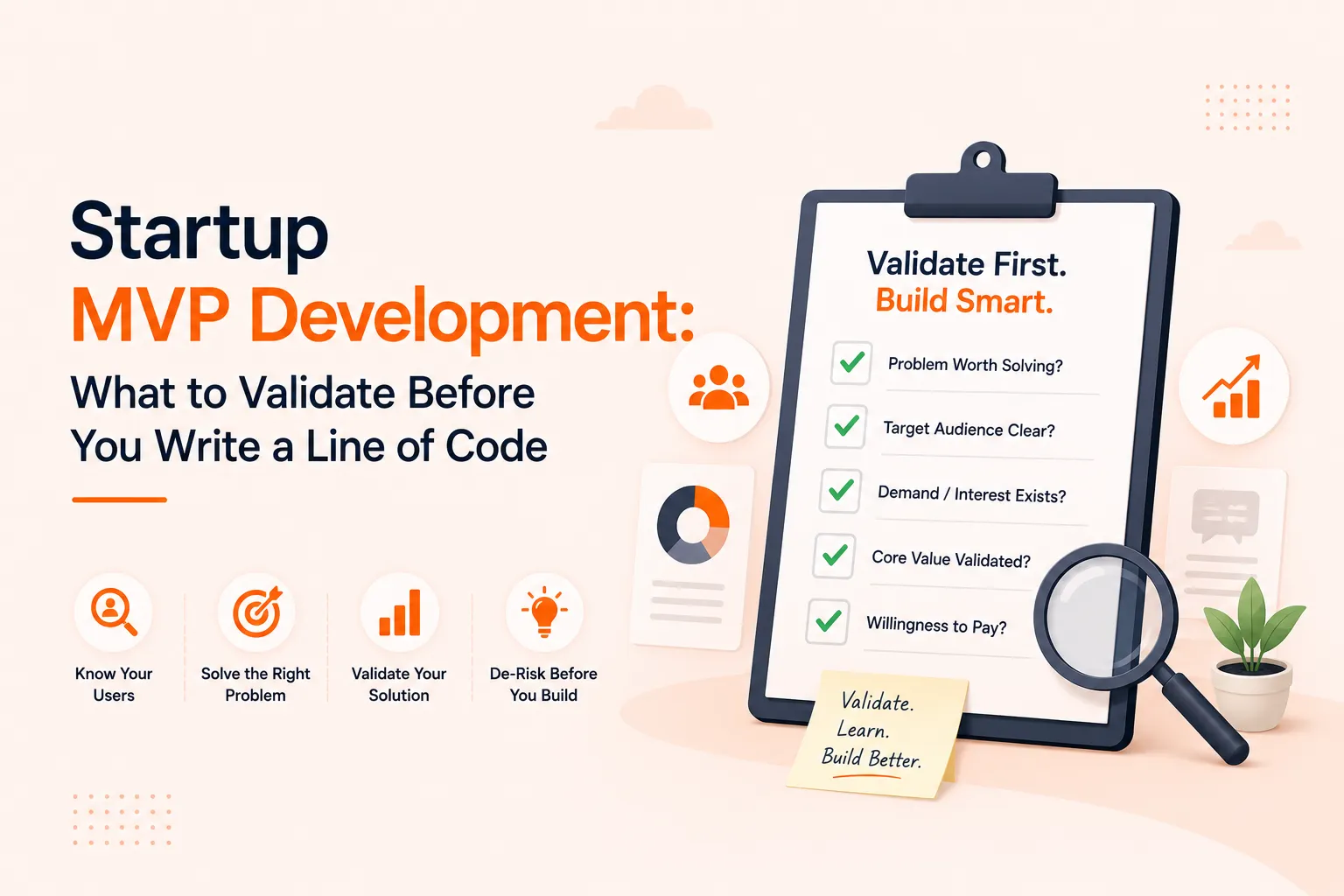
A Simple Validation Checklist
Before writing your first line of code, use this checklist to evaluate whether your startup idea is ready for MVP development.
Is the problem real and worth solving?
Have you spoken with potential customers?
Do you clearly understand your target audience?
Is there evidence of market demand?
Have you researched existing competitors?
Are your MVP features limited to solving one core problem?
Do you know how you'll measure success after launch?
If you answered "No" to several of these questions, spend more time validating before development begins.
The earlier you discover gaps, the less expensive they are to fix.
Frequently Asked Questions
What should startups validate before building an MVP?
Startups should validate the problem they are solving, their target audience, market demand, competitor landscape, business model, and core MVP features before beginning development.
How do you validate a startup idea before writing code?
You can validate a startup idea by interviewing potential customers, conducting surveys, researching competitors, creating landing pages, collecting early sign-ups, and testing demand before investing in product development.
Why is product validation important for startup MVP development?
Product validation reduces the risk of building features that users don't need. It helps startups make informed decisions, improve product-market fit, and launch with greater confidence.
What is the difference between idea validation and MVP development?
Idea validation confirms that a real customer problem exists and that people are interested in a solution. MVP development is the process of building a basic product to test that validated idea with real users.
How do you know if your startup idea has market demand?
Signs of market demand include positive customer interviews, waiting list sign-ups, pre-orders, survey responses, and consistent feedback from your target audience showing genuine interest in your solution.
When should a startup begin MVP development?
A startup should begin MVP development after validating the problem, identifying its target customers, confirming market demand, and defining the minimum set of features needed to solve the core problem.
Validate First, Build with Confidence
Successful startups rarely begin with perfect products, they begin with a deep understanding of the problem they're solving.
Taking time to validate your idea before writing code helps you reduce risk, avoid unnecessary development costs, and build an MVP that addresses real customer needs. By confirming the problem, audience, demand, and essential features early, you create a stronger foundation for long-term growth.
Remember, the goal of startup MVP development isn't to build everything. It's to build the right thing first.
Ready to Turn a Validated Idea Into a Successful MVP?
If you've validated your startup idea and are ready to move forward, the next step is building an MVP that is focused, scalable, and ready for real users.
Every successful MVP starts with validation, not code. If you've confirmed there's real demand for your idea, the next step is turning those insights into an MVP that solves the right problem and can grow with your startup.
Contact Us for more information.