Building a SaaS product is exciting. Building the wrong SaaS product is expensive.
Many founders start with ambitious ideas and long feature lists, only to discover that customers want something different. That's why successful startups focus on validation before scaling. Instead of investing heavily in a fully featured product, they launch a Minimum Viable Product (MVP) to test demand, gather feedback, and reduce risk.
For early-stage SaaS startups, the goal isn't to build more features—it's to learn faster and move closer to product-market fit.
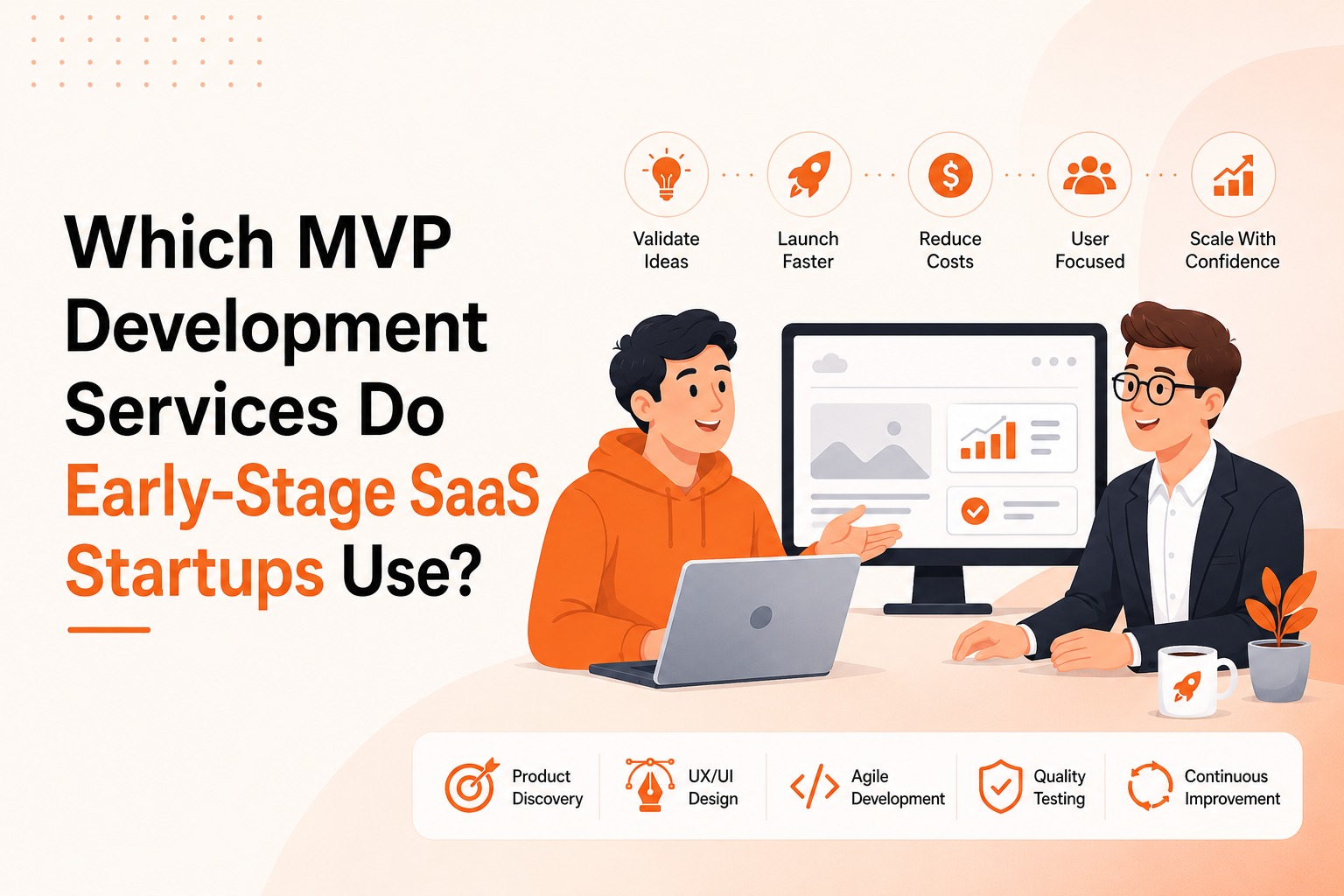
Modern MVP development services for startups go beyond coding. The best product development team helps founders validate ideas, reduce risk, and accelerate learning before investing in large-scale product development. This guide explores the MVP development services early-stage SaaS startups use to move toward product-market fit.
What Is SaaS MVP Development?
An MVP, or Minimum Viable Product, is the simplest version of a product that solves a real problem for a specific group of users.
SaaS MVP development helps founders validate product ideas before investing heavily in full-scale SaaS development. The purpose is to learn whether the idea is worth pursuing before investing significant time and money.
The approach is closely aligned with Lean Startup principles, which emphasize experimentation, customer feedback, and iterative learning over extensive upfront planning. Research published by Harvard Business Review notes that successful startups often test assumptions early, collect customer feedback, and adapt quickly as they search for a repeatable business model.
For founders building MVPs for startups, the MVP serves as a learning tool that helps answer important questions:
-
Is the problem important enough to solve?
-
Do users find value in the solution?
-
Which features matter most?
-
Will customers eventually pay for it?
-
Can the product retain users over time?
The answers often shape the future of the business more than the original idea itself.
Why Early-Stage SaaS Startups Rely on MVP Development Services
Many founders initially think of an MVP agency as a team that writes code. In reality, successful MVP development involves much more than software engineering.
The cost of building the wrong product is usually far greater than the cost of refining the right one.
Early-stage startups often need support with product discovery, UI/UX design, prototype development, SaaS architecture, product strategy, and agile development. Rather than building an internal team from day one, founders often work with MVP development companies or a dedicated development team that already has experience launching startup products.
Benefits of SaaS MVP Development
1. Faster Time-to-Market
Speed is one of the biggest advantages of working with an MVP software development agency.
Experienced teams help founders move from idea to launch quickly, allowing them to collect feedback sooner and validate assumptions faster.
2. Lower Development Costs
Building an in-house team before validation can be expensive and risky.
MVP software development services provide access to specialized talent without the long-term costs associated with full-time hiring.
3. Access to Product Expertise
One of the hardest parts of building an MVP for startups is deciding what not to build.
Founders are often tempted to include every feature they can imagine. Experienced MVP development teams bring an outside perspective and help prioritize the smallest feature set required for validation.
In many SaaS MVP projects, 70–80% of the originally proposed features never become critical to customer adoption. The challenge isn't identifying what to build; it's identifying what can wait.
This disciplined approach helps startups launch faster, reduce development costs, and focus on solving the core problem that matters most to early users.
4. Reduced Product Risk
Research from Startup Genome has identified premature scaling as one of the most common reasons startups struggle.
By validating assumptions before expanding development efforts, founders can make more informed product decisions and reduce the risk of building features customers don't need. The best MVP solutions for startups are designed to generate learning early, helping teams invest in growth only after they have evidence that the product is solving a real problem.
The Core MVP Software Development Services SaaS Startups Typically Use
Successful SaaS products rarely emerge from a single development sprint. They evolve through a series of steps designed to reduce uncertainty, validate assumptions, and improve the product over time.
That's why most founders don't rely on a single MVP Development Service. Instead, they use a combination of services that support product discovery, development, testing, launch, and ongoing iteration.
Let's look at the core services that early-stage SaaS startups focus on:
|
Priority
|
MVP Development Service
|
Purpose
|
|
Critical
|
Product Discovery
|
Validate the problem and market need
|
|
Critical
|
UI/UX Design
|
Create intuitive user experiences
|
|
Critical
|
MVP Software Development
|
Build core functionality
|
|
Critical
|
Quality Assurance Testing
|
Ensure reliability
|
|
Important
|
Launch Support
|
Deploy and monitor the product
|
|
Important
|
Product Analytics
|
Measure user behavior
|
|
Important
|
Product Iteration
|
Improve based on feedback
|
Let's explore each service in more detail.
1. Product Discovery and Validation
Before any design mockups or code are created, the most effective teams focus on understanding the problem they're solving.
In many SaaS MVP projects, founders begin with dozens of feature ideas. Product discovery often reveals that users only need one or two core workflows, helping teams launch faster and validate demand sooner. This stage often has the biggest impact on the success of a SaaS startup because it ensures the team is solving the right problem in the first place.
Typical product discovery activities include:
-
Customer interviews
-
Competitor analysis
-
Market research
-
User persona development
-
Feature prioritization
-
Product roadmap planning
Skipping this phase can lead to one of the most common startup mistakes: building a solution before fully understanding the problem.
For example
A founder may begin with a vision for a complete project management platform that includes reporting, collaboration tools, workflow automation, and integrations. During product discovery, customer interviews often reveal that users care most about solving one specific workflow problem. Instead of building ten features, the startup launches with two or three core capabilities that directly address that need. This focused approach shortens development timelines and generates feedback much earlier, making validation more efficient.
2. UI/UX Design and Prototype Development
Once the product direction is clear, the next step is to transform ideas into experiences that users can interact with.
UI/UX design is not just about visual appeal. It helps founders test workflows, validate assumptions, and identify friction before investing heavily in development.
Most MVP app development services include:
-
User journeys
-
Information architecture
-
Wireframes
-
Interactive prototypes
-
User flow design
-
Interface design
For SaaS products, usability directly impacts adoption and retention. A well-designed prototype allows startups to test not only whether users need the product, but also whether they can use it easily.
3. MVP Software Development
This is the stage most founders associate with MVP development.
Once the product strategy and designs are validated, the development team begins building the core functionality required to test the product in the market.
MVP software development services typically include:
-
Frontend development
-
Backend development
-
Database setup
-
API integrations
-
Authentication systems
-
Core business logic
The goal is not to build every planned feature. The goal is to build enough functionality to validate demand and gather meaningful feedback.
A successful MVP is measured by the quality of learning it generates—not by the number of features it contains.
4. SaaS Architecture Planning
While MVPs are intentionally lightweight, they still require a solid technical foundation.
A SaaS development company will often help founders make key architectural decisions early, including:
Successful SaaS development requires balancing scalability, performance, and speed to market. Good SaaS architecture reduces technical debt and prevents expensive rework as the product grows.
5. Quality Assurance and Testing
Speed matters, but reliability matters too.
Launching a buggy product can produce misleading feedback because users may abandon the product due to technical issues rather than a lack of interest in the concept.
Quality assurance services commonly include:
-
Functional testing
-
Regression testing
-
Usability testing
-
Performance testing
-
Security reviews
Testing helps ensure founders receive accurate feedback about the product itself rather than its technical shortcomings.
6. MVP Launch and Deployment
Building the product is only part of the process. Getting it into users' hands requires a successful launch.
Many founders fear launching too early, but launching too late is often a bigger risk. Delayed launches postpone customer feedback, making it harder to validate assumptions and improve the product based on real-world usage.
Most MVP development companies provide launch support, such as:
-
Cloud deployment
-
Hosting configuration
-
Monitoring tools
-
Error tracking
-
Analytics implementation
These systems help founders understand how users interact with the product from day one.
More importantly, they provide the data needed to make informed product decisions after launch.
7. Post-Launch Product Iteration
Many first-time founders view launch as the finish line.
In reality, launch is where learning begins.
Once users start interacting with the product, startups gain access to real-world feedback that can guide future development. This stage is critical for improving retention, refining the value proposition, and moving closer to product-market fit.
Post-launch services often include:
-
Product analytics
-
User feedback analysis
-
Feature prioritization
-
Roadmap refinement
-
Ongoing development
According to Atlassian's Agile guidance, iterative development allows teams to continuously improve products based on evidence and user feedback rather than assumptions. This principle sits at the heart of the MVP development process.
Which MVP Development Services Are Essential vs. Optional?
Many first-time founders burn months building features customers never asked for. At the MVP stage, every feature should contribute to learning. If a SaaS development service does not help validate assumptions or improve decision-making, it can often wait until later.
|
Service
|
Essential for MVP?
|
Why
|
|
Product Discovery
|
Yes
|
Validates demand before development
|
|
UI/UX Design
|
Yes
|
Improves usability and adoption
|
|
MVP Development
|
Yes
|
Builds core functionality for validation
|
|
QA Testing
|
Yes
|
Ensures reliability and user satisfaction
|
|
Launch Support
|
Yes
|
Enables successful deployment and monitoring
|
|
Product Analytics
|
Recommended
|
Measures user behavior and engagement
|
|
AI Features
|
Usually No
|
Rarely required for initial validation
|
|
Advanced Automation
|
Usually No
|
Can be added after product validation
|
|
Enterprise Integrations
|
Usually No
|
Not essential for early-stage testing
|
|
Complex Reporting Systems
|
Usually No
|
Better suited for later growth stages
|
The objective of MVP development services for startups isn't to build everything on day one. It's to learn enough about your customers, product, and market to make the next decision with confidence.
Common Mistakes When Building an MVP for a SaaS Startup
One of the biggest challenges when building an MVP for startups is deciding which features to exclude. Successful founders focus on validation rather than feature completeness. Most MVP failures aren't caused by poor development—they happen because teams validate too late or build too much before learning from real users.
-
Building too many features instead of focusing on a single core problem
-
Skipping product discovery and customer validation
-
Launching too late in pursuit of a "perfect" product
-
Ignoring user feedback and market signals
-
Choosing a development partner without startup or SaaS experience
-
Prioritizing features over learning and validation
-
Building based on assumptions rather than real customer needs
-
Failing to define clear MVP goals and success metrics
-
Investing heavily before validating market demand
-
Overcomplicating the product architecture too early
SaaS MVP Development Cost: What Should Founders Expect?
Understanding SaaS MVP development cost is critical for founders who want to validate their product without exhausting valuable runway.
The final SaaS MVP development cost depends on the complexity of the product, the number of features required for validation, third-party integrations, security requirements, and the experience level of the MVP development company.
Geographic location of the development team, product discovery requirements, UI/UX complexity, regulatory or compliance considerations, and integration needs can also significantly influence overall development costs.
Most SaaS startups fall into one of the following categories:
|
SaaS MVP Type
|
Typical Cost Range
|
Example
|
|
Simple SaaS MVP
|
$15,000–$35,000
|
Internal tools, scheduling platforms, workflow management apps
|
|
Standard SaaS MVP
|
$35,000–$80,000
|
CRM platforms, project management software, and vertical SaaS products
|
|
Complex SaaS MVP
|
$80,000–$150,000+
|
AI-powered SaaS, fintech platforms, healthcare SaaS, multi-tenant enterprise software
|
Several factors influence SaaS MVP development cost:
-
Product discovery and validation requirements
-
UI/UX design complexity
-
User authentication and role management
-
Subscription billing systems
-
Third-party integrations
-
Security and compliance requirements
-
Cloud infrastructure and SaaS architecture
-
Post-launch support
For most early-stage SaaS startups, a standard SaaS MVP costs between $35,000 and $80,000. This range is usually sufficient to build core functionality, launch to early adopters, collect feedback, and validate product-market fit before investing in full-scale product development.
Why Startups Invest in MVP Development Services
-
Validate demand before scaling
-
Reduce development risk
-
Launch faster
-
Attract investors with real traction
-
Gather customer feedback early
The purpose is not to build every planned feature. It is to build the smallest SaaS MVP capable of validating customer demand and generating meaningful learning.
How to Choose the Right SaaS MVP Development Company
Choosing an MVP development company is one of the most important decisions you'll make as a founder. When evaluating MVP development services for startups, founders should prioritize validation expertise over feature delivery alone.
A reliable SaaS MVP development company should understand startup validation, product-market fit, and iterative product development rather than focusing solely on coding.
When evaluating a SaaS MVP development company, founders should look beyond technical expertise and assess product strategy, startup experience, and post-launch support.
Here are a few factors worth evaluating before making a decision.
Look for SaaS Experience
Building SaaS products requires specialized expertise in areas such as user onboarding, subscription models, retention, scalability, and SaaS architecture.
Ask potential partners to share examples of similar SaaS MVP development projects they've completed and the outcomes those products achieved.
Evaluate Their Discovery Process
A strong MVP development company doesn't start by discussing technology.
It starts by understanding your customers, market, business goals, and assumptions.
If a team is ready to provide a quote without conducting any form of product discovery, that should raise concerns. The best SaaS MVP development begins with understanding the problem before building the solution.
Assess Communication Practices
Successful SaaS MVP development is highly collaborative.
Look for clear communication processes, regular progress updates, transparent reporting, and a structured feedback loop. Good communication often has a greater impact on project success than technical expertise alone.
Review Previous MVP Projects
Past work reveals how a team approaches validation, iteration, and startup challenges.
Look beyond visual design and ask questions such as:
-
How quickly was the MVP launched?
-
What assumptions were tested?
-
How did the product evolve after launch?
-
Did the startup continue development with the same team?
The answers often reveal more than a portfolio ever could.
Red Flags to Watch Before Building MVPs for Startups
Not every MVP development agency focuses on validation. Before choosing product strategy and development services, watch for these warning signs:
-
They discuss features before understanding the problem.
-
They provide estimates without a discovery process.
-
They encourage large feature sets for an initial MVP.
-
They focus on development output rather than learning outcomes.
-
They have little experience with SaaS startups.
The best MVP development services prioritize validation, challenge assumptions, and help founders launch with the smallest feature set necessary to gather meaningful feedback.
Frequently Asked Questions
How much do MVP Development Services cost?
Most MVP development services cost between $15,000 and $150,000+, depending on product complexity, integrations, design requirements, and security needs. For most SaaS startups, a standard MVP typically costs between $35,000 and $80,000, which is usually sufficient to validate demand, collect feedback, and prepare for future growth.
How long does it take to build an MVP for a SaaS startup?
Most SaaS MVP development projects take between 6 and 12 weeks. The timeline depends on the scope of features, design complexity, integrations, and testing requirements. Simpler products can launch faster, while AI-powered or compliance-heavy SaaS platforms often require additional development time.
How do I choose an MVP development company?
Look for an MVP development company with experience building products for startups, a structured product discovery process, transparent communication practices, and a proven track record of launching MVPs. The best partners focus on validation and learning outcomes rather than simply delivering features.
What is the difference between an MVP and a prototype?
A prototype is a visual or interactive representation of a product used to test concepts and user flows. An MVP is a functional product with core features that real users can use. While prototypes validate ideas, MVPs validate market demand and user behavior.
Can I launch a SaaS MVP without a technical co-founder?
Yes. Many founders successfully launch SaaS MVPs without a technical co-founder by partnering with an MVP development company or an experienced development team. These partners provide product strategy, design, development, testing, and launch support, allowing founders to focus on validation and business growth.
How do MVP development services help SaaS startups reduce risk?
MVP development services help SaaS startups reduce risk by validating customer demand before significant investment. Through product discovery, prototype development, MVP software development, testing, and early user feedback, founders can identify market opportunities, validate assumptions, and avoid building features customers do not need. This reduces wasted development costs and improves the chances of achieving product-market fit.
Final Thoughts
Successful SaaS startups rarely win because they build more features than their competitors.
They win because they learn faster. Effective SaaS MVP development allows founders to validate assumptions, reduce risk, and make informed product decisions before scaling.
That's why MVP development services for startups have become an essential part of how modern SaaS founders validate ideas and reduce risk. From product discovery and UI/UX design to MVP software development services, testing, launch support, and ongoing iteration, every stage is designed to reduce risk and improve decision-making.
For early-stage founders, the objective isn't to build a perfect product on the first attempt. It's to validate a problem, learn from real users, and steadily move toward product-market fit.
The sooner those lessons arrive, the stronger the foundation for long-term growth.
Ready to Take the Next Step?
The most successful SaaS products rarely start with dozens of features. They start with a clear problem, a focused MVP, and a willingness to learn from users quickly.
If you're exploring how to validate your SaaS idea, Multisyn Tech can help you move from concept to launch with a structured MVP development approach focused on validation, rapid learning, and long-term product growth.