Learn how API-first MVP development helps startups launch faster, integrate easily, and scale without rebuilding. Explore benefits, architecture, and best practices.
API-First MVP Development: Benefits for Growing Startups
Most founders focus on launching their MVP as quickly as possible. But the real challenge often begins after the first customers arrive. New feature requests, mobile apps, third-party integrations, and product updates can quickly expose architectural limitations that slow growth. That's why choosing the right development approach from the start matters.
Many startups discover that adding new features, launching a mobile app, or integrating third-party tools takes far longer than expected, not because the idea is wrong, but because the product wasn't built to grow. Rebuilding an MVP can consume valuable time, budget, and engineering effort when every sprint matters.
That's why many growing startups are turning to API-first MVP development. By designing a reusable API layer before building the user interface, founders can validate their ideas today while creating a scalable foundation for tomorrow.
Key Takeaways
-
API-first MVP development separates your application's business logic from its user interface, making it easier to scale and maintain.
-
Reusable APIs allow you to launch web, mobile, and future applications without rebuilding the backend.
-
API-first architecture simplifies third-party integrations, supports faster product iterations, and reduces long-term technical debt.
-
This approach is ideal for SaaS startups and growing businesses that plan to add new features, platforms, or AI capabilities over time.
-
While it requires more upfront planning, API-first MVP development can reduce future development costs and create a stronger foundation for long-term growth.
What Is API-First MVP Development?
Before discussing its advantages, let's first understand what API-first MVP development actually means.
An Application Programming Interface (API) is a bridge that allows different software applications to exchange data and communicate with each other. Whether your product processes online payments, sends notifications, or connects with a CRM, APIs make those interactions possible.
In a traditional MVP, teams usually build the frontend and backend together to launch as quickly as possible. While this approach works for an initial release, it often creates tightly connected systems that become difficult to modify as the product evolves.
An API-first approach takes a different path.
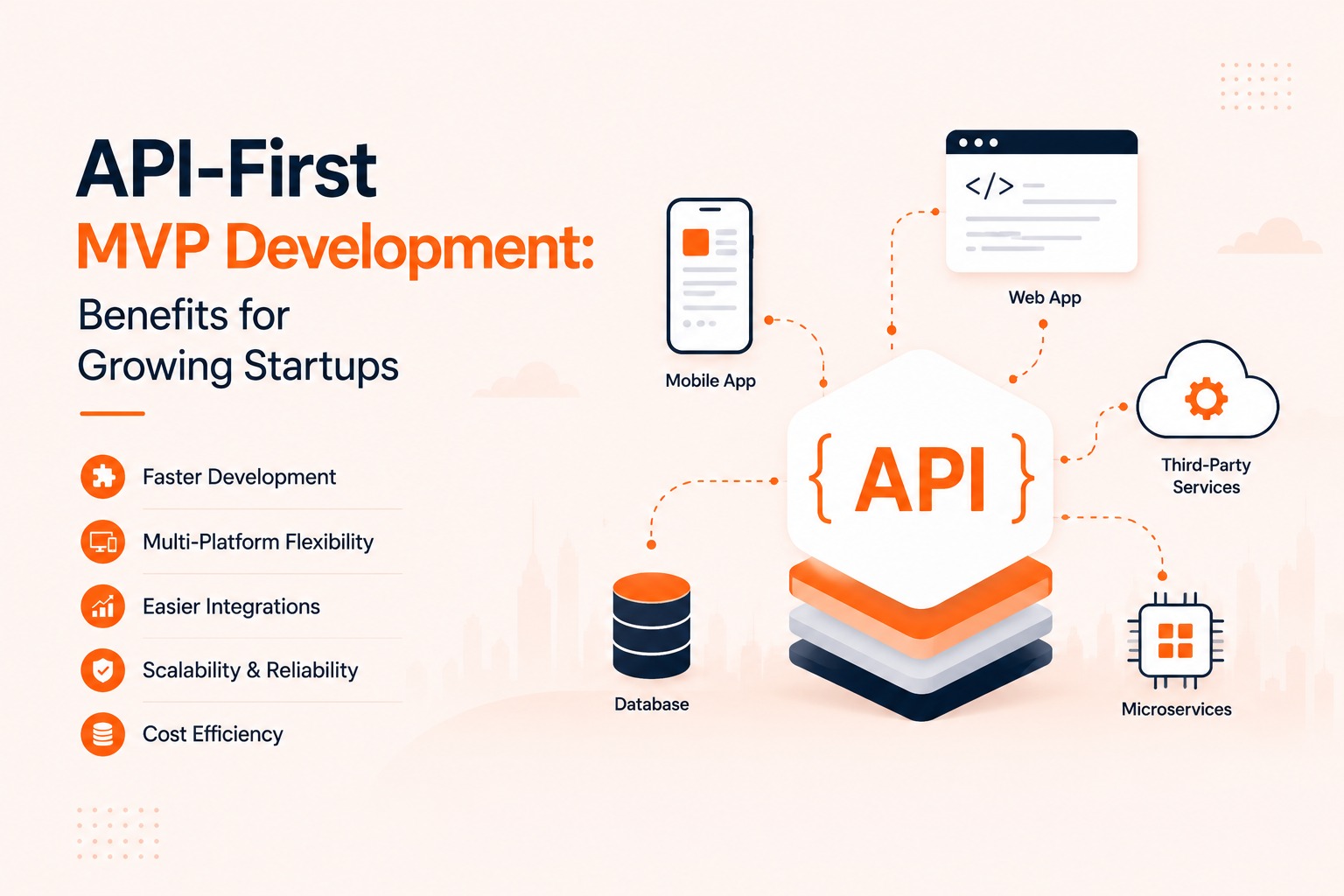
Instead of starting with the interface, developers first design the APIs that define how data and business logic will be shared across the application. Once those APIs are ready, multiple platforms can use the same backend.
The architecture looks like this:
|
Business Logic
│
▼
REST / GraphQL APIs
│
┌─────────────┼─────────────┐
▼ ▼ ▼
Web App Mobile App Third-Party Apps
|
This separation makes the product far more flexible. The same APIs can power a web application today and a mobile app, customer portal, or third-party integration tomorrow.
As a result, development teams spend less time rewriting functionality and more time improving the product.
This approach has become increasingly common among modern software companies because it supports faster innovation and reusable digital services. Gartner identifies APIs as a key enabler of digital business, helping organizations build connected and scalable applications.
More importantly, for startups, an API-first MVP isn't about adding unnecessary complexity. It's about making smart architectural decisions early so the product can grow without requiring a complete rebuild.
Traditional MVP vs. API-First MVP: What's the Difference?
Every MVP is built with the same goal: to validate an idea quickly and learn from real users. The difference lies in how the product is designed to evolve after that initial launch.
A traditional MVP focuses on delivering a working product as fast as possible. An API-first MVP also prioritizes speed but introduces a reusable API layer that supports future platforms, integrations, and product expansion.
Neither approach is universally better. The right choice depends on your product vision, expected growth, and technical requirements.
The table below highlights the key differences:
|
Feature
|
Traditional MVP
|
API-First MVP
|
|
Development Approach
|
Frontend and backend are developed together to achieve a fast launch.
|
APIs are designed first, creating a reusable backend before building user interfaces.
|
|
Scalability
|
Works well for early validation but may require architectural changes as the product grows.
|
Designed to support future growth with minimal restructuring.
|
|
Mobile App Expansion
|
Additional backend work may be needed for new platforms.
|
The same APIs can power web, iOS, Android, and other applications.
|
|
Third-Party Integrations
|
Integrations are often added individually as new requirements arise.
|
Standardized APIs simplify future integrations with external services.
|
|
Team Collaboration
|
Frontend and backend development are often more dependent on each other.
|
Teams can work in parallel using well-defined API contracts.
|
|
Maintenance
|
Updates may affect multiple parts of the application.
|
Modular architecture makes maintenance and feature updates easier.
|
|
Long-Term Cost
|
Lower upfront planning but potentially higher maintenance costs over time.
|
Slightly more planning initially, often reducing future development effort.
|
|
Best For
|
Simple validation projects, prototypes, or products with limited expansion plans.
|
Startups planning to scale, support multiple platforms, or integrate with other systems.
|
At first glance, both approaches can deliver a functional MVP within similar timelines. However, the difference becomes more apparent as the product evolves.
For example, imagine a SaaS startup launching a web-based project management platform. A traditional MVP can help the founders validate demand quickly. But if the business later decides to launch mobile apps, integrate with tools like Slack or Stripe, or offer a public API for enterprise customers, significant backend changes may be required.
With an API-first MVP, much of that groundwork has already been established. Because the core business logic is exposed through reusable APIs, new platforms and integrations can be added more efficiently without rebuilding the application's foundation.
That doesn't mean every startup needs an API-first architecture from day one. If you're building a simple prototype, an internal tool, or a landing page MVP to test market interest, a traditional approach may be sufficient.
However, if your roadmap includes mobile applications, third-party integrations, AI-powered features, or rapid product expansion, investing in API-first MVP development early can reduce technical debt and support faster growth.
Now that we've explored how these approaches differ, let's examine the specific business benefits that make API-first MVP development an increasingly popular choice for growing startups.
Benefits of API-First MVP Development for Growing Startups
After comparing traditional and API-first MVPs, the next question is straightforward: What practical advantages does an API-first approach offer?
For growing startups, the answer goes beyond technical architecture. API-first MVP development can reduce future development effort, support faster product expansion, and make it easier to adapt as customer needs evolve.
Let's look at the key benefits.
Launch Fast Without Limiting Future Growth
Startups often face pressure to release a product before competitors or before funding runs out. That urgency makes speed a top priority.
However, launching quickly shouldn't mean creating obstacles for future growth.
With an API-first MVP, developers build reusable backend services that support both the initial release and future product updates. This allows founders to validate their idea without locking themselves into an architecture that becomes difficult to scale.
Build Once, Expand Across Multiple Platforms
Customer expectations change as startups grow.
A product that starts as a web application may eventually need an iOS app, an Android app, an admin dashboard, or even a customer portal.
With an API-first architecture, these platforms can all use the same backend APIs. Instead of recreating business logic for every new application, development teams simply build new interfaces that connect to existing services.
This reduces duplicate work and helps startups launch new platforms more efficiently.
Simplify Third-Party Integrations
Very few software products operate in isolation.
As your business grows, you may need to connect with payment gateways, CRM platforms, analytics tools, communication software, or AI services.
If APIs are already part of your MVP architecture, adding these integrations becomes significantly easier.
This flexibility allows startups to respond faster to customer requests while reducing the development effort required for future partnerships.
According to Postman's 2024 State of the API Report, organizations increasingly view APIs as strategic assets because they accelerate innovation and simplify system integration across products.
Improve Development Team Productivity
An API-first approach doesn't just benefit the product. It also improves the way development teams work.
Because API specifications are defined early, frontend and backend developers can work simultaneously instead of waiting for one another.
This parallel workflow reduces bottlenecks and shortens development cycles.
As the team grows, having clearly defined APIs also makes onboarding new developers easier, since they can understand how different parts of the system communicate.
Support Faster Product Iterations
Every successful startup evolves based on customer feedback.
New features, design improvements, and workflow changes are all part of the product journey.
When business logic is separated from the user interface, many frontend updates can be made without extensive backend changes. Likewise, backend improvements can often be introduced without disrupting the customer experience.
This flexibility enables teams to iterate more frequently and respond to user feedback with greater confidence.
Prepare for Future AI and Automation
Many startups are now exploring AI-powered features such as chatbots, recommendation engines, workflow automation, and intelligent search.
These capabilities often rely on APIs to exchange data between different systems.
An API-first MVP provides the connectivity needed to integrate AI services more efficiently as product requirements evolve.
Rather than redesigning the application later, startups can build on the existing API layer to introduce new capabilities.
Reduce Long-Term Development Costs
API-first development may require more architectural planning during the early stages, but that investment often pays off over time.
Reusable APIs reduce duplicate development, simplify maintenance, and make future enhancements more predictable.
Instead of repeatedly rebuilding similar functionality for different platforms, teams can focus on delivering new features that create business value.
Over time, engineering teams spend less time rewriting existing functionality and more time delivering new features. This allows startups to allocate development budgets toward innovation rather than maintaining duplicated codebases.
For startups with limited budgets, avoiding unnecessary redevelopment can free up valuable engineering resources.
Create a Better Foundation for Scaling
Growth introduces new challenges.
More users, additional features, new integrations, and larger development teams all increase product complexity.
An API-first architecture helps manage that complexity by keeping the application modular and easier to maintain.
Is API-First MVP Development Right for Your Startup?
Not every MVP needs an API-first architecture. However, if your product is expected to grow beyond its first release, planning for scalability early can save significant time and development costs.
Choose an API-First MVP if you plan to:
✅ Launch both a web and a mobile application
✅ Integrate with payment gateways, CRMs, or third-party platforms
✅ Add AI-powered features in future releases
✅ Build a SaaS product with long-term scalability in mind
✅ Support multiple user roles through separate dashboards
✅ Offer partner or public APIs
✅ Continuously release new features based on customer feedback
✅ Scale your engineering team over time
If you checked three or more of these boxes, an API-first MVP is likely the better long-term choice.
When Should Startups Choose API-First MVP Development?
Not every startup requires an API-first architecture from day one.
If you're building a simple proof of concept or testing demand with a lightweight prototype, a traditional MVP may be enough.
However, an API-first approach becomes increasingly valuable when long-term growth is part of your product strategy.
An API-first MVP is a strong choice if you plan to:
-
Launch both web and mobile applications.
-
Integrate with payment gateways, CRMs, or other third-party platforms.
-
Add AI-powered features in future releases.
-
Support multiple user roles through separate dashboards.
-
Build a SaaS platform with long-term scalability in mind.
-
Offer partner or public APIs as your business grows.
-
Continuously release new features based on customer feedback.
If several of these goals are already on your roadmap, investing in API-first MVP development early can help reduce technical debt and support faster expansion.
On the other hand, if your immediate objective is simply validating an idea with a limited feature set and no near-term plans for expansion, a traditional MVP may still be the right starting point.
The key is choosing an architecture that aligns with your business goals, not just your launch timeline.
Best Practices for Building an API-First MVP
Choosing an API-first approach is only the first step. To realize its full benefits, startups need to build APIs that are secure, reusable, and flexible enough to support future growth.
Here are some best practices to keep in mind.
Design APIs Before Writing Code
An API-first MVP starts with planning.
Before development begins, define how different parts of the application will communicate. This includes identifying endpoints, data structures, authentication methods, and expected responses.
Clear API design reduces misunderstandings, improves collaboration, and minimizes costly changes later in the project.
Build for Today's Needs, Not Every Future Possibility
A common misconception is that API-first development means building an extensive backend before launching.
It doesn't.
The goal is to design APIs that support your current MVP scope while allowing room for future expansion. Avoid adding endpoints or functionality that aren't tied to your immediate product goals.
Keeping the architecture simple helps maintain development speed without creating unnecessary complexity.
Keep APIs Consistent
Consistency makes APIs easier to use and maintain.
Use clear naming conventions, standardized response formats, and predictable error messages across every endpoint.
Whether your team grows or new integrations are introduced, consistent APIs reduce confusion and improve development efficiency.
Prioritize Security from the Beginning
Even an MVP handles valuable business and customer data.
Implement secure authentication, role-based access where appropriate, encrypted data transmission, and input validation from the start.
Addressing security early is significantly easier than retrofitting it after the product gains users.
Document Your APIs
Good documentation benefits both internal teams and future partners.
It explains how endpoints work, what data they expect, and how responses should be handled.
As your product evolves, documentation becomes an essential resource for onboarding developers, supporting integrations, and maintaining consistency across projects.
Test APIs Continuously
Reliable APIs create reliable products.
Automated API testing helps identify issues before they reach production, reducing regressions as new features are added.
Combined with functional and integration testing, it ensures that updates don't unintentionally disrupt existing functionality.
Common Mistakes to Avoid
Even with an API-first strategy, a few common mistakes can reduce its long-term value. Avoid these pitfalls to build an MVP that's both scalable and maintainable.
Designing APIs After the Frontend
An API-first approach starts with the API. Building the frontend first often leads to inconsistent endpoints and unnecessary rework.
Over-Engineering the MVP
Focus on the features needed to validate your idea. Avoid building APIs for future scenarios that don't support your current MVP goals.
Ignoring API Documentation
Well-documented APIs make development, onboarding, and future integrations much easier. Keep documentation updated as the product evolves.
Skipping API Versioning
As your product grows, APIs will change. Versioning helps introduce updates without breaking existing applications or integrations.
Neglecting Security
Protect your APIs from the start with authentication, authorization, input validation, and encrypted data transmission. Fixing security gaps later is far more difficult.
Not Testing APIs Regularly
Automated API testing helps catch issues early, ensuring new features don't disrupt existing functionality or integrations.
How API-First MVP Development Supports Long-Term Growth
An MVP is rarely the final version of a product.
Successful startups continuously evolve by introducing new features, entering new markets, and responding to customer feedback.
An API-first architecture makes that journey easier.
The same backend can support web applications, mobile apps, customer portals, partner platforms, and future integrations without repeatedly rebuilding core functionality.
It also creates opportunities to adopt emerging technologies more quickly.
Whether you're introducing AI-powered features, integrating with enterprise software, or expanding into new channels, reusable APIs provide the flexibility to move faster.
As your engineering team grows, modular architecture also improves collaboration, simplifies maintenance, and reduces development bottlenecks.
For startups planning beyond the initial launch, these long-term advantages often outweigh the additional planning required during the MVP stage.
Why Choose Multisyn for API-First MVP Development?
We believe an MVP should do more than validate an idea. It should create a strong foundation for long-term product growth.
Our team works closely with founders to understand their business goals, technical requirements, and product roadmap before development begins. This allows us to design API-first architectures that balance rapid delivery with future scalability.
Our API-first MVP development approach includes:
-
Product discovery and technical planning
-
Scalable API architecture design
-
Web and mobile-ready backend development
-
Secure authentication and API integrations
-
Quality assurance and automated testing
-
Cloud deployment and ongoing technical support
Whether you're building your first SaaS product, expanding an existing platform, or preparing for future integrations, we help you launch with confidence while reducing the need for costly redevelopment later.
Frequently Asked Questions
What is API-first MVP development?
API-first MVP development is an approach where APIs are designed before the user interface. Instead of building separate backends for different platforms, the same APIs power web applications, mobile apps, and future integrations. This creates a scalable foundation that allows startups to add new features and platforms without rebuilding core functionality.
Is API-first MVP development suitable for every startup?
No. If you're building a simple prototype or testing a basic idea, a traditional MVP may be enough. However, startups planning to launch mobile apps, integrate with third-party services, or scale their product over time often benefit from an API-first architecture, as it reduces the need for future redevelopment.
Does API-first MVP development increase development costs?
Not necessarily. API-first development may require more planning during the discovery phase, but it often lowers long-term costs by reducing duplicate development, simplifying maintenance, and making future integrations easier. For many startups, the upfront investment pays off as the product grows.
Can an API-first MVP support both web and mobile applications?
Yes. One of the biggest advantages of API-first development is that the same backend APIs can serve multiple platforms. This allows startups to launch web, iOS, and Android applications using the same business logic, reducing development time and ensuring a more consistent user experience.
What types of startups benefit most from API-first MVP development?
API-first MVP development is ideal for SaaS startups, marketplaces, fintech, healthcare, logistics, and AI-driven products. It is especially valuable for businesses that expect to scale quickly, integrate with external platforms, or launch multiple customer-facing applications.
How long does API-first MVP development take?
The timeline depends on the product's complexity, feature set, and integration requirements. Most startup MVPs can be designed and developed within 8 to 12 weeks, while simpler products with fewer features may be completed in less time.
Can an existing MVP be converted into an API-first architecture?
Yes. Existing MVPs can be refactored to expose reusable APIs, although the effort depends on the application's architecture and technical debt. Planning for API-first earlier usually reduces redevelopment work later.
What technologies are commonly used for API-first MVP development?
API-first MVPs are commonly built using technologies such as Node.js, NestJS, ASP.NET Core, Django, Laravel, or Spring Boot, along with REST or GraphQL APIs and cloud platforms like AWS, Azure, or Google Cloud. The ideal technology stack depends on the product's scalability and business requirements.
Final Thoughts
Building an MVP is about more than launching quickly. It's about making decisions that support the product's future.
An API-first MVP gives startups the flexibility to expand across platforms, integrate with new technologies, and respond to customer feedback without constantly rebuilding their application. While it requires thoughtful planning upfront, it often reduces technical debt and creates a stronger foundation for long-term growth.
If your startup plans to evolve beyond its first release, API-first MVP development can be a strategic investment that saves time, lowers future development costs, and prepares your product for sustainable growth.
Choosing the right architecture early can help reduce technical debt, simplify future integrations, and support faster product growth as your startup evolves.
Build an MVP That's Ready to Scale
The architecture you choose today will influence how easily your product grows tomorrow. Whether you're building a SaaS platform, marketplace, or AI-powered application, an API-first MVP can help you launch faster while avoiding costly rebuilds as your business evolves.
At Multisyn, we help startups design and develop scalable API-first MVPs that balance rapid validation with long-term growth. From product discovery and API architecture to development, testing, and deployment, our team works as an extension of yours to bring your vision to market.
Ready to build an MVP that grows with your startup? Book a free discovery call and let's discuss your product goals.
CTA Button: Schedule a Discovery Call