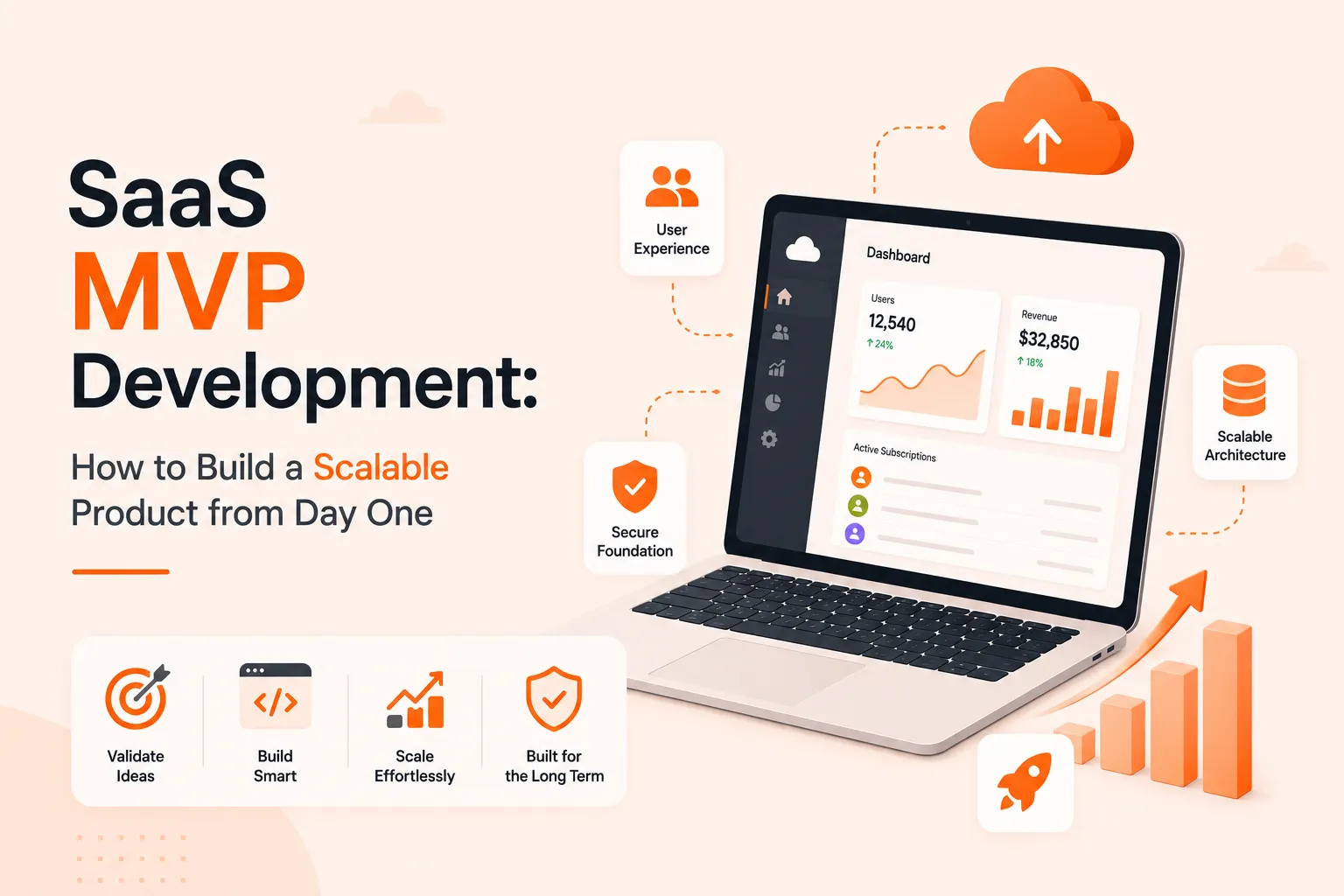
Building a SaaS MVP isn't simply about launching quickly. It's about validating a business idea while making architectural decisions that won't require expensive rewrites six months later. Many startups either overbuild before finding product-market fit or underinvest in technical foundations that become bottlenecks as they grow. This guide explains how experienced SaaS teams balance speed, scalability, and validation from day one.
A well-planned SaaS MVP helps you avoid both problems. It lets you validate your product with real users while building on a technical foundation that can support future growth. In this guide, you'll learn how to build a scalable SaaS MVP, choose the right architecture and tech stack, estimate development costs, avoid common mistakes, and prepare your product for long-term success.
What Is a SaaS MVP? (And What It's Not)
A SaaS MVP is a functional, user-ready product that solves one core problem with the minimum set of features required to deliver value and gather real user feedback. It is not a rough idea or a half-built demo. It is a usable product designed for early adopters.
MVP vs. Prototype vs. Proof of Concept
Understanding these distinctions is critical for making the right product decisions:
-
Prototype: A visual or interactive representation of a product used to demonstrate design and user flow. It is not fully functional and is mainly used for internal validation or stakeholder feedback.
-
Proof of Concept (PoC): A technical experiment that validates whether a specific idea or feature can be built. It focuses on feasibility rather than usability or user experience.
-
MVP (Minimum Viable Product): A live, functional product with real users, designed to test market demand and gather actionable feedback. It includes essential features and is built for learning, not perfection.
Founder Insight: One misconception we frequently see is founders treating an MVP as a "cheap version" of the final product. In reality, an MVP should be a focused product designed to validate assumptions quickly while creating a technical foundation that can evolve as the business grows.
What a Real SaaS MVP Includes
A true SaaS MVP goes beyond just a basic interface. It includes the foundational elements required to operate as a real product:
-
User Authentication: Secure sign-up, login, and account management
-
One Core Workflow: The primary feature that solves the user’s main problem
-
Billing Integration: Subscription setup, payment processing, and basic pricing tiers
-
Basic Admin Panel: Minimal controls to manage users, data, or system activity
-
Landing Page: A simple, conversion-focused page to explain the product and capture users
These components ensure that your MVP is not just functional, but also capable of supporting real
Why Most SaaS MVPs Fail to Scale?
Many SaaS MVPs fail not because of poor ideas, but due to flawed execution decisions made early in development. Instead of focusing on validation and scalability, teams often prioritize speed or feature expansion, which creates long-term limitations.
-
Overbuilding unnecessary features: Adding too many features too early increases complexity, slows development, and makes scaling harder.
-
Ignoring system architecture early: Without a scalable foundation, even small user growth can lead to performance issues and technical debt.
-
Choosing the wrong tech stack: Selecting tools that don’t support scalability can limit flexibility and require costly migrations later.
-
No product-market validation: Building without validating demand often results in products that don’t meet real user needs.
-
Poor database and backend planning: Inefficient data structures and backend logic can cause bottlenecks as usage grows.
According to CB Insights, 43% of startups fail due to a lack of market need, making it the single biggest reason for failure. McKinsey also reports that 70% of digital transformation projects fail to meet their goals, often due to poor planning and scalability issues early in development.
These insights highlight a clear pattern: without proper validation and scalable architecture, even well-funded SaaS MVPs struggle to grow sustainably.
Many early-stage startups assume scalability only becomes important after gaining thousands of users. In practice, poor architectural decisions often begin affecting development speed long before traffic becomes an issue. Small technical compromises made during the MVP stage can become expensive to fix once new features and integrations are introduced.
Key Principles of Scalable SaaS MVP Development
The difference between an MVP that struggles and one that scales comes down to a few key principles.
Build for Validation, Not Perfection
When building an MVP, the goal isn’t to create something perfect. It’s to learn fast. The most successful SaaS founders focus on solving one clear problem instead of trying to do everything at once.
It’s tempting to add more features “just in case,” but that usually backfires. Extra features slow you down, complicate the product, and delay real feedback from users.
Engineering Recommendation: If every feature cannot be directly connected to validating a customer assumption, postpone it until after launch.
Design with Scalability in Mind
Even if your MVP is small, your thinking shouldn’t be. A simple product can still be built on a flexible foundation. Using a modular structure and an API-first approach makes it easier to expand, integrate, and adapt as your product grows.
You don’t need over-engineering, but you do need foresight.
Best Practice: Modular monolithic architecture is often the best balance between development speed and future scalability for first-time SaaS startups.
Choose the Right Tech Stack Early
Your tech stack isn’t just a development decision; it’s a growth decision. The tools you choose today will either support your scaling efforts or slow them down later.
Frameworks like Node.js or Django, combined with a cloud-first approach, give you the flexibility to handle increasing numbers of users without major rewrites.
Practical Tip: Choose technologies your future team can easily maintain rather than selecting frameworks simply because they are currently popular.
Prioritize Performance & Security
Early users expect your product to work smoothly and keep their data safe. Slow load times or basic security gaps can break trust instantly.
Focus on handling basic load, optimizing performance, and implementing essentials like secure authentication and data protection from the start.
|
Founder insight: The MVPs that scale successfully aren’t the ones built the fastest: they’re the ones built with clear priorities and a foundation that doesn’t break when growth begins.
|
Step-by-Step Process to Build a Scalable SaaS MVP
Building a scalable SaaS MVP isn’t a one-step task; it’s a structured process. Each stage builds on the previous one, helping you move from an idea to a product that’s ready to grow.
Step 1: Market Research & Problem Validation
Before writing a single line of code, you need clarity on who you’re building for and why. Identify your target users, understand their pain points, and validate whether your solution actually solves a real problem.
This step reduces the biggest risk in SaaS: building something no one needs.
Step 2: Define Core Features (Lean Scope)
Once the problem is clear, focus only on the features required to solve it. Separate must-have features from nice-to-have ones and keep your scope intentionally small.
A lean feature set helps you launch faster and keeps your product easier to scale.
Step 3: UX/UI for Early Adoption
Your MVP doesn’t need to be perfect, but it does need to be usable. A simple, intuitive design helps users understand your product quickly, while fast onboarding reduces friction and improves early retention.
If users can’t figure out your product in minutes, they won’t stick around.
Step 4: Scalable Architecture Planning
Even at the MVP stage, your technical foundation matters. Decide whether a monolith or microservices approach fits your current needs, and design your database carefully to avoid bottlenecks later.
The goal is not to over-engineer, but to avoid decisions that limit growth.
Step 5: Development & Iteration
Build your MVP using an agile approach, focusing on small, iterative releases. Follow a simple loop: build, test, learn, and improve.
This keeps development aligned with real user feedback instead of assumptions.
Step 6: Launch & Collect Feedback
Once your MVP is ready, launch it to a controlled group of users. Use beta testing and analytics tools to understand how people interact with your product.
The insights you gather here will guide your next set of improvements and help you scale with confidence.
Best Tech Stack Choices for Scalable SaaS MVPs
At this stage, your goal isn’t to chase the trendiest tools; it’s to choose a stack that helps you move fast now without limiting your ability to scale later. A well-balanced tech stack supports rapid development, handles growth smoothly, and keeps future iterations flexible.
|
Layer
|
Options
|
Best For
|
Scalability
|
|
Frontend
|
React, Next.js
|
Fast, responsive UI + SEO
|
High
|
|
Backend
|
Node.js, Python, Ruby
|
APIs, logic, fast development
|
High
|
|
Database
|
PostgreSQL, MongoDB
|
Structured vs flexible data
|
High
|
|
Cloud
|
AWS, GCP, Azure
|
Infrastructure & scaling
|
High
|
|
DevOps
|
CI/CD, Docker
|
Automation & deployments
|
Essential
|
Choosing the right combination here sets the tone for everything that follows: from performance to scalability to how easily your team can ship updates as your product grows.
How to Choose the Right Tech Stack
Instead of selecting technologies based solely on popularity, evaluate them against four criteria:
For most SaaS startups, simple and maintainable architectures outperform highly complex enterprise stacks during the MVP stage.
Scalability Strategies from Day One
Once your MVP is live, the focus shifts from building to handling growth. The right scalability strategies ensure your product doesn’t break when users start showing up.
Cloud Infrastructure (Auto-Scaling)
Using cloud platforms with auto-scaling allows your app to handle traffic spikes without manual intervention. As demand increases, resources scale automatically. So performance stays consistent.
According to the Flexera 2026 State of the Cloud Report, cloud adoption continues to mature as organizations prioritize business value, centralized governance, and scalable cloud infrastructure. The report also highlights that public cloud remains the dominant deployment model for enterprise workloads, making cloud-first architecture a practical choice for SaaS products that expect future growth.
Microservices vs Monolith (When to Switch)
Most MVPs start as a monolith because it’s faster to build and easier to manage. But as your product grows, breaking it into microservices can improve flexibility and scalability.
The key is timing: don’t over-engineer early, but don’t wait too long either.
Caching Strategies
Caching reduces the load on your servers by storing frequently accessed data. This improves response times and keeps your app fast, even under heavy traffic.
Load Balancing
Load balancers distribute incoming traffic across multiple servers. This prevents any single server from becoming a bottleneck and improves overall reliability.
API Optimization
Efficient APIs are critical for performance. Reduce unnecessary data transfer, optimize queries, and ensure your endpoints are fast and scalable.
Small improvements here can make a big difference at scale.
Common Mistakes to Avoid
Even with the right strategy, small mistakes early on can slow down your growth later. Avoiding these can save time, money, and technical debt.
Building Too Many Features Early
Trying to do too much too soon leads to complexity and delays. Focus on solving one core problem really well.
Ignoring Backend Scalability
A frontend may look great, but if your backend can’t handle growth, your product will struggle. Scalability starts behind the scenes.
No Clear Roadmap After MVP
Launching is just the beginning. Without a clear plan for iteration and growth, your MVP can quickly lose direction.
Underestimating User Growth
If your product gains traction, traffic can increase faster than expected. Without preparation, this can lead to downtime and poor user experience.
Skipping Testing
Untested features lead to bugs, crashes, and user frustration. Even in an MVP, basic testing is non-negotiable.
How Much Does a Scalable SaaS MVP Cost?
The cost of SaaS MVP development depends on much more than the number of features. Factors such as product complexity, UI/UX design, third-party integrations, security requirements, and the development team's experience all influence the final budget. A well-planned MVP focuses on solving one core problem while avoiding unnecessary features that increase both development time and cost.
For most startups, a custom SaaS MVP with essential functionality typically costs between $15,000 and $35,000. Products that require multi-tenant architecture, advanced integrations, role-based access, or more sophisticated workflows generally range from $35,000 to $80,000 or more.
What Influences SaaS MVP Development Cost?
Several factors determine how much you'll invest in building your MVP:
-
Feature complexity: Core workflows, dashboards, user management, and advanced business logic require more development effort than simple CRUD functionality.
-
UI/UX design: A polished, intuitive interface improves user adoption but requires additional design and usability testing.
-
Third-party integrations: Connecting payment gateways, CRMs, authentication providers, analytics tools, or external APIs adds development time.
-
Technology stack: The frameworks, cloud infrastructure, and database architecture you choose affect both initial development and long-term maintenance costs.
-
Security and compliance: Features such as secure authentication, encryption, role-based permissions, and compliance requirements (e.g., GDPR or HIPAA) increase development scope.
-
Quality assurance: Comprehensive testing across devices, browsers, and user scenarios helps reduce bugs before launch.
-
Post-launch maintenance: Ongoing updates, monitoring, performance optimization, and feature enhancements should be included in your long-term budget planning.
Typical SaaS MVP Cost Breakdown
|
Build Path
|
Typical Cost
|
Best for
|
|
No-code MVP
|
$3,000–$10,000
|
Validating demand before investing in custom development
|
|
Custom-built SaaS MVP
|
$15,000–$35,000
|
Startups launching a scalable product with essential features
|
|
Advanced SaaS MVP
|
$35,000–$80,000+
|
Products requiring complex workflows, integrations, or multi-tenant architecture
|
|
Enterprise SaaS Platform
|
$80,000+
|
Businesses scaling after achieving product-market fit
|
Founder Insight: The cheapest MVP is rarely the most cost-effective. Many startups spend less initially by building only the essentials, validating their assumptions quickly, and expanding the product based on real customer feedback instead of assumptions. This approach often prevents expensive rebuilds and unnecessary feature development later.
According to Clutch, custom software development pricing varies significantly depending on project complexity, team size, and development location, making it important to define your MVP scope before requesting estimates.
For a detailed breakdown of pricing by feature set, development model, and project scope, see our MVP Development Cost Guide.
Example: Building a Scalable SaaS MVP
One B2B SaaS startup approached our team with an idea for a workflow automation platform. Instead of building all planned features, we prioritized authentication, workflow creation, notifications, and analytics.
The MVP launched in under three months, allowing the founders to validate demand before expanding the product roadmap. Based on early customer feedback, nearly half of the originally planned features were removed, significantly reducing development costs while improving usability.
When to Scale Your SaaS MVP
Scaling too early can break your product. Scaling too late can slow your growth. The key is knowing exactly when your SaaS MVP is ready to move to the next stage.
Signs You’re Ready to Scale
You don’t scale based on assumptions. You scale based on signals:
-
Consistent user growth
Not just traffic spikes, but steady acquisition and retention over time.
-
Product-market fit
Users are actively using your product, coming back, and even recommending it.
-
Performance gaps are starting to show
Slower load times, system strain, or small failures under increased usage.
These are indicators that your MVP is no longer “testing”. It’s becoming a real product.
What to Scale First
Scaling isn’t about doing everything at once. It’s about fixing the right things first:
-
Infrastructure → Improve performance, uptime, and load handling
-
Team → Bring in specialists to speed up development and reduce bottlenecks
-
Features → Expand based on real user behavior—not assumptions
The smartest SaaS startups scale what users are already demanding.
How the Right MVP Development Partner Helps?
At the MVP stage, speed matters. However, direction matters more.
That’s why many startups work with experienced SaaS teams.
They don’t just build fast: they build right.
Outsourcing helps you move more quickly with proven workflows. You get skilled developers without long hiring delays. Also, you avoid the overhead of building a full team too early.
So you can focus on what actually matters: validation and growth.
Questions to Ask Before Hiring an MVP Development Partner
-
Have they built SaaS MVPs before?
-
Can they explain architectural decisions?
-
Will they help prioritize features?
-
Do they provide post-launch support?
-
Can they estimate scaling costs?
Benefits of Experienced SaaS Teams
A strong SaaS team doesn’t just build features. They build scalable systems:
-
Architecture designed for long-term growth
-
Clean, maintainable code that’s easy to scale
-
Faster iterations based on real product feedback
They’ve already seen what works—and what fails—so you don’t have to learn the hard way.
Where the Right Partner Makes the Difference
The biggest advantage isn’t just development. It’s decision-making.
The right partner helps you avoid overbuilding, choose the right tech stack, and align your MVP with future scalability from day one. An experienced development team works closely with startups to turn early-stage ideas into scalable SaaS products without unnecessary complexity or delays.
Founder Checklist Before Scaling Your SaaS MVP
-
☐ Are users consistently signing up and returning?
-
☐ Do you have clear signs of product-market fit (usage, retention, referrals)?
-
☐ Is your core feature being used as intended (not ignored or misunderstood)?
-
☐ Are performance issues starting to appear under increased usage?
-
☐ Do you have analytics in place to track user behavior and bottlenecks?
-
☐ Is your infrastructure ready to handle traffic spikes (or easily upgradeable)?
-
☐ Have you validated pricing with real users (not assumptions)?
-
☐ Do you have a clear roadmap based on user feedback—not guesswork?
-
☐ Is your codebase clean enough to scale without major rewrites?
-
☐ Do you know what to scale first (infra, team, or features)?
Frequently Asked Questions
1. What features should a SaaS MVP include?
A SaaS MVP should include only the features needed to solve one core user problem. Most SaaS MVPs include user authentication, a primary workflow, a simple dashboard, payment integration (if required), an admin panel, and basic analytics. Avoid adding secondary features until you've validated demand through real user feedback.
2. What is the best tech stack for SaaS MVP development?
The best tech stack depends on your product requirements, scalability goals, and development timeline. Popular choices include React or Next.js for the frontend, Node.js or Django for the backend, PostgreSQL or MongoDB for the database, and AWS, Azure, or Google Cloud for infrastructure. Prioritize maintainability and scalability over trendy technologies.
3. Can a SaaS MVP scale as the business grows?
Yes. A well-designed SaaS MVP can scale if it's built with modular architecture, cloud infrastructure, and a flexible technology stack. While early-stage products don't need enterprise-level complexity, planning for future growth helps avoid costly rewrites as user numbers, features, and integrations increase.
4. Should I build an MVP before seeking funding?
In many cases, yes. An MVP helps demonstrate product-market fit, validate customer demand, and show traction to potential investors. Even a simple working product with early users is often more convincing than an idea alone because it reduces investment risk and provides measurable market validation.
5. How long does it take to build a SaaS MVP?
The development timeline depends on the product's complexity and feature set. A no-code MVP may take two to four weeks, while a custom SaaS MVP typically takes 8–14 weeks. Projects with advanced workflows, third-party integrations, or custom infrastructure may require additional development time.
6. When should I start scaling my SaaS MVP?
You should scale your SaaS MVP after validating product-market fit and seeing consistent user growth, strong retention, and increasing system demand. Scaling too early can waste resources, while waiting too long may lead to performance issues and poor user experience. Use customer feedback and analytics to guide your scaling decisions.
7. What's the difference between a SaaS MVP and a prototype?
A prototype is a visual or interactive representation used to test concepts and gather feedback, but it isn't a fully functional product. A SaaS MVP is a working application that real users can access. Its purpose is to validate market demand, collect user feedback, and guide future product development.
8. How do I choose the right SaaS MVP development partner?
Look for a development partner with experience building SaaS products, validating startup ideas, and designing scalable architectures. They should help prioritize features, recommend the right technology stack, communicate transparently, and provide post-launch support. A strong partner focuses on long-term product success rather than simply delivering code.
Ready to Build a SaaS MVP That Scales?
Building a scalable SaaS MVP is about validating your business idea without sacrificing long-term growth. By focusing on one core problem, prioritizing essential features, selecting the right technology stack, and using scalable architecture from the start, startups can reduce development costs, avoid technical debt, and iterate based on real user feedback. A well-planned MVP creates the foundation for achieving product-market fit and scaling efficiently as demand grows.
Every SaaS product starts with assumptions. The goal of an MVP isn't to prove you're right; it's to learn quickly, reduce risk, and build only what customers truly need. At Multisyn Tech, we help startups validate ideas, define lean feature sets, and develop scalable SaaS MVPs that are ready to grow without unnecessary complexity. If you're planning your first SaaS product, schedule a free discovery session to discuss your roadmap, technology choices, and development strategy.
Book a free discovery session to discuss your product roadmap, technology choices, and development strategy.