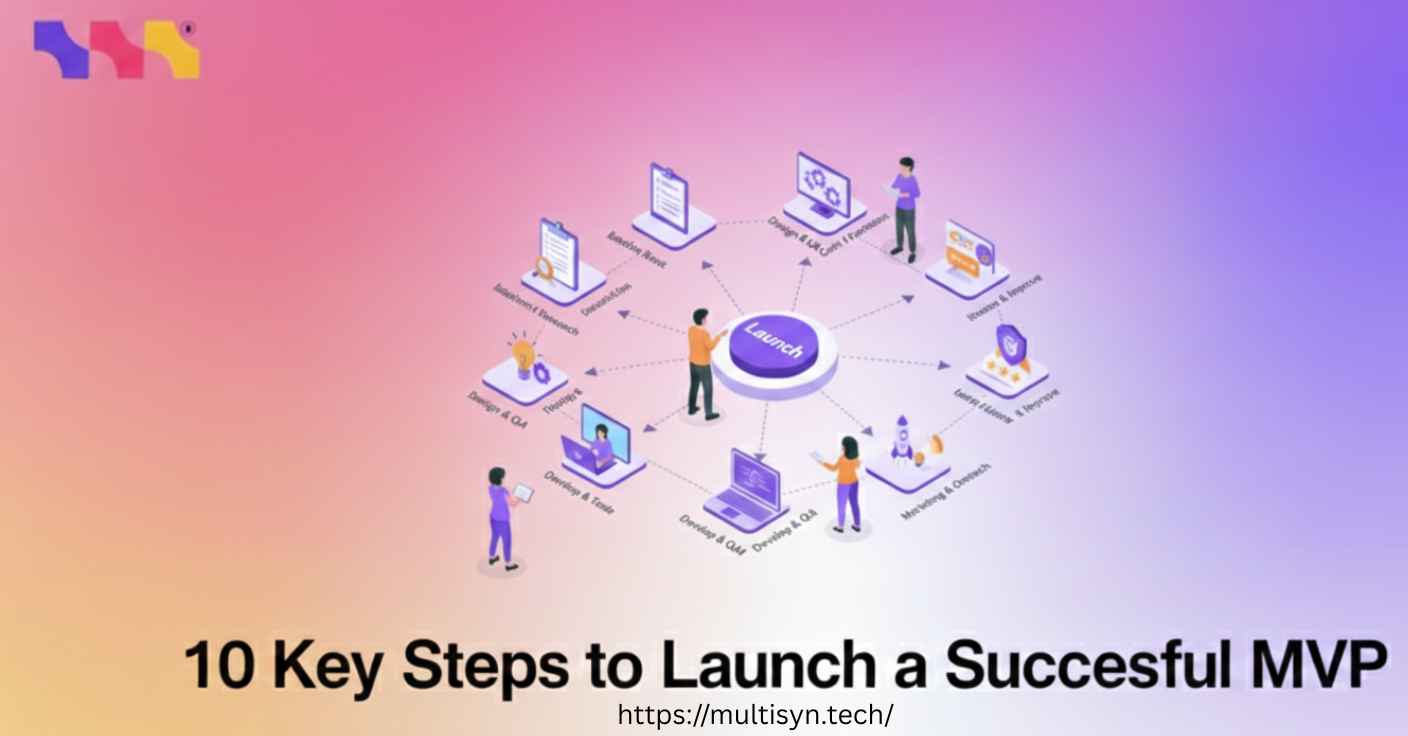
Building a Minimum Viable Product (MVP) means launching the simplest working version of your idea, one with just enough features to solve a real problem and let you test it with actual users. For startups, this is the fastest way to prove demand before spending months and thousands of dollars on a full build. Below are the 10 steps we walk startup founders through when developing an MVP, from defining the problem to preparing for scale.
Key Takeaways
-
Start with one clear problem and one clear audience, not a feature list
-
Cut anything that isn't essential to proving your core idea works
-
Market research and early user feedback should shape your feature priorities, not guesswork
-
Pick a tech stack that can scale later without a rebuild
-
Track KPIs like acquisition, engagement, and retention from day one
-
Treat your MVP as a starting point for iteration, not a finished product
Minimum Viable Product (MVP) is an extremely important part of the startup process, as it helps a startup rapidly prove the idea with the smallest amount of resources. By focusing on the main features that can help solve specific issues, MVP creation enables you to assess market demand, reduce risk, and save time and costs.
It is a process that helps assemble rich user feedback, product refinements, and launch success. This blog will describe 10 key steps to create and launch an MVP that satisfies the needs of users and paves the way for additional development in the future, focusing on MVP development for startups.
1. Define Your Core Problem and Target Audience
Start by identifying the single most important problem your product solves and who it solves it for. Information about your target audience's pain points will assist in development. Regardless of whether you are developing an MVP for a startup or working on MVP development for enterprises, aim to solve a crucial problem that potential users can identify with. The more obvious your perspective is, the more likely your MVP is to be successful in the market.
2. Explain the Key Features of Your Product
Your MVP for software development should include only the features required to solve the core problem you defined in step one. Avoid adding extra features that could delay the launch. Keep your product simple and focused on the core features that clearly show the value it provides. For software startups, this means addressing the most critical pain points of your users.
3. Conduct Market Research
Market research tells you whether the problem you're solving is one people will actually pay to fix, and how competitors are currently solving it. It is noteworthy that whether you are developing a startup or an MVP for a large corporation, you need to understand the existing market environment. Most early-stage founders spend two to four weeks on structured research (competitor teardown, customer interviews, and pricing analysis) before writing a single line of code. When you examine the competitors, you can gain valuable information about customers' needs and gaps. This knowledge will not only assist you in making a more efficient MVP but will also allow you to prevent the pitfalls and errors that are likely to happen.
4. Give Feedback Priority to Features
Rank features by how directly they support your core problem, using feedback from potential customers rather than internal opinion. The initial response from your target audience will help you refine your MVP's features. This action will be very essential in verifying your product idea. The next phase of product development is based on customer input and the creation of a roadmap.
5. Choose the Right Technology Stack
Pick a technology stack that can support your MVP today and scale with you later, without forcing a rebuild. Whether you're building an MVP for a startup or an enterprise, ensure your tech stack aligns with your business goals. Opt for flexible frameworks and systems that allow for easy iteration and future scaling, without the need for major redesigns. This ensures that your MVP can grow and adapt as user demands evolve. If you're weighing whether to hire in-house, work with freelancers, or bring in a dedicated development team, the right stack choice often depends on which route you take.
6. Build Your MVP with a Lean Approach
A lean MVP build focuses only on the features needed to test your core assumption, nothing more. This method is cost-effective and saves time by focusing on the essentials. By developing an MVP, a simple version of your product, you can gather early feedback, validate your ideas, and refine your MVP without unnecessary delays. Most lean MVP builds take six to twelve weeks, depending on scope; if you're budgeting for this stage, our breakdown of MVP development costs covers what typically drives that range up or down.
7. Test Your MVP with Early Users
Before a wider launch, put your MVP in front of a small group of early users and watch how they actually use it. Introduce it to a select group of early users to understand how they interact with your product. Collect their feedback on what works, what doesn't, and what could be improved. Their input will guide you in making necessary adjustments before investing more resources in further development.
8. Track Key Metrics
Once your MVP is live, monitor the KPIs that show whether it's actually working for users. Metrics like user acquisition, engagement, and retention rates help you assess how well your MVP resonates with your target audience. By tracking these numbers, you can make informed decisions about whether to pivot or invest further in scaling your product.
|
Metric
|
What It Measures
|
Typical Early-Stage Signal
|
|
User acquisition rate
|
How fast are new users signing up
|
Steady week-over-week growth, even if small
|
|
Activation rate
|
% of new users who complete a key first action
|
30-50% is a healthy starting range
|
|
Retention rate
|
% of users still active after 30 days
|
20%+ is a reasonable early benchmark for most SaaS MVPs
|
|
Engagement frequency
|
How often do active users return
|
Varies by product, but should trend upward post-iteration
|
9. Iterate Based on Feedback
Use what you learned from testing and your KPIs to make targeted improvements, not a full redesign. Focus on enhancing the user experience, refining features, and fixing any bugs. This continuous process of iteration is crucial for long-term success and ensures your product evolves based on real user needs and feedback.
10. Prepare for Scale
Once your MVP is validated and optimized, shift focus to the architecture and features that will support growth. Find out how to enhance the architecture of your MVP, add new features, and increase the number of users. This is a very sensitive task, transforming an MVP into a full-scale product, and this step is critical for any founder or startup MVP development company aiming to build long-term success. However, with proper planning, your MVP will provide a solid foundation to build on.
FAQs
1. What is an MVP?
An MVP (Minimum Viable Product) is a simplified version of a product that includes only the core features needed to solve a specific problem for early users. It allows startups to launch quickly, test their idea in the market, and collect feedback to guide future development without investing in a full-featured product upfront
2. Why is an MVP important for startups?
An MVP is important because it helps startups validate their idea with minimal time and cost. Instead of building a complete product, startups can test demand, gather real user feedback, and make data-driven decisions. This reduces risk, avoids wasted resources, and increases the chances of building a product that truly meets market needs.
3. How long does it take to build an MVP?
Most MVPs can be designed, developed, and launched within 8 to 12 weeks, depending on the project's complexity, feature scope, and development team. The objective is to launch quickly, gather feedback, and improve through continuous iterations rather than delaying the release to build a perfect product.
4. What are the key features to include in an MVP?
You can test an MVP by releasing it to a small group of early users and collecting feedback through surveys, interviews, and usage analytics. Observing how users interact with the product helps identify pain points, validate assumptions, and guide improvements for future versions based on real-world behavior.
5. Can AI help build an MVP faster?
Yes. AI can accelerate tasks such as market research, wireframing, coding assistance, testing, documentation, and customer support. However, it cannot replace customer validation or strategic product decisions. Founders should use AI to improve efficiency while continuing to rely on real user feedback to shape the product.
6. How do I test my MVP with users?
After launching an MVP, the next step is to analyze user feedback and performance data to refine the product. Startups typically iterate by improving existing features, fixing issues, and gradually adding new functionality based on user needs, ensuring the product evolves in the right direction.
The Bottom Line
A successful MVP isn't about building fast. It's about building just enough to learn what your users actually need, then using that feedback to shape what comes next. The startups that get this right treat their MVP as the first step in an ongoing process, not a finished product.
Whether you're building an MVP for a startup or scaling one for an enterprise, the same principle holds: solve one real problem well, test it with real users, and let their feedback drive your next move. That's what separates products that find traction from ones that stall after launch.
Ready to build your MVP? Talk to our team, and we'll help turn your idea into a working product, fast.