Many startup founders have a promising idea and a clear vision of the product they want to build. However, before investing months of development time and a significant budget into a full-scale product, it's worth asking one important question: Has the idea been validated with real users?
Many successful startups begin by testing assumptions rather than building every planned feature from day one. This approach aligns with the Lean Startup methodology, which encourages founders to build a minimum viable product (MVP), measure how customers respond, and use those insights to guide future development. Instead of relying on assumptions, an MVP helps validate market demand, test the business model, and identify the features users value most before making larger investments.
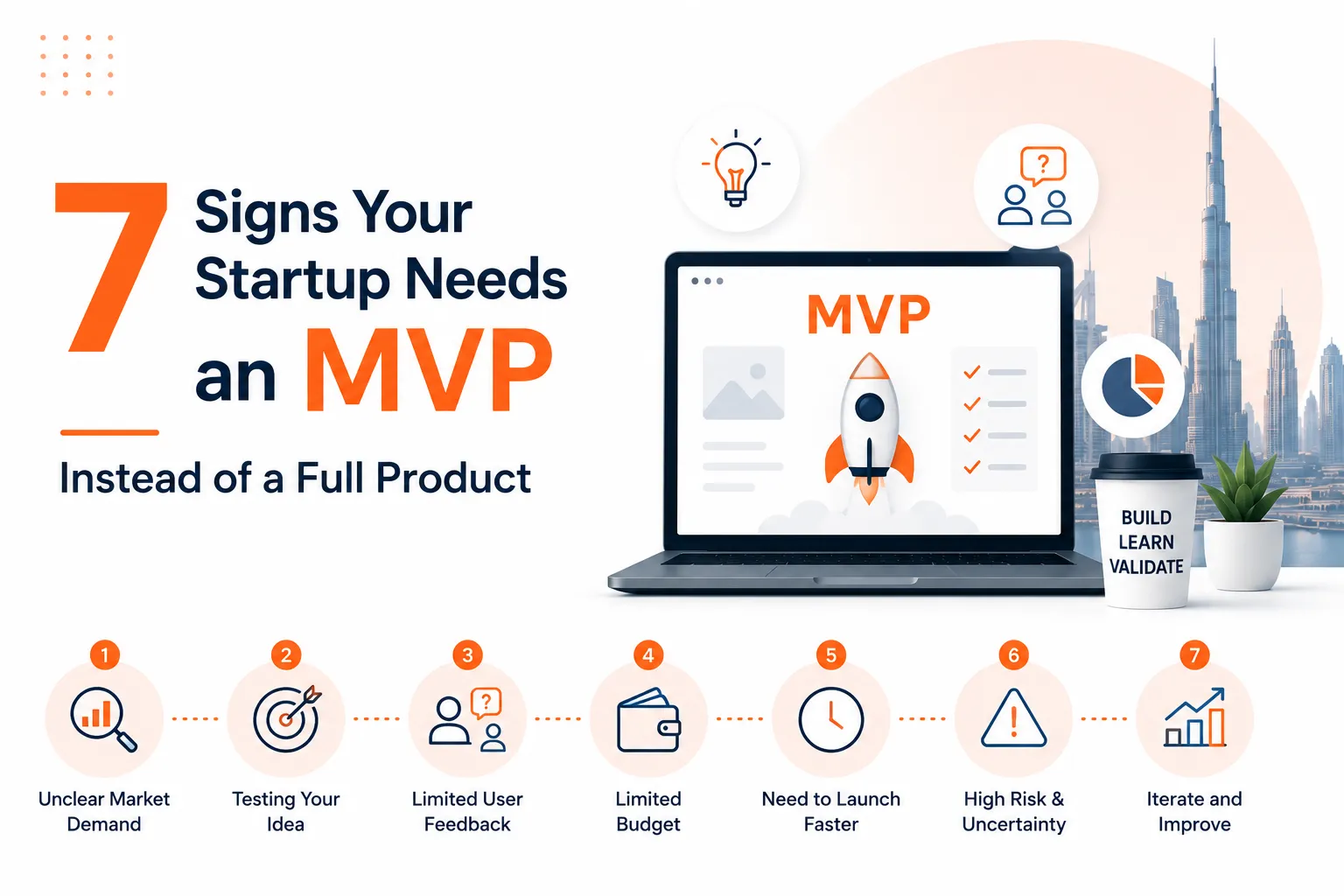
If you're still evaluating product-market fit, gathering customer feedback, or deciding which features should be included in the final product, starting with an MVP can reduce risk and support better decision-making. Below are seven signs that indicate your startup may benefit more from an MVP than a fully developed product.
MVP vs. Full Product: What's the Difference?
The difference between an MVP and a full product isn't simply the number of features.
An MVP is a focused version of a product built around a specific problem, target audience, and core use case. It should be functional enough to provide real value while allowing the startup to learn from actual users.
A full product is generally broader. It may include advanced features, multiple workflows, integrations, automation, analytics, and infrastructure designed to support a larger user base.
The right choice depends largely on how much you already know about your customers and the product you're building.
|
Factor
|
MVP
|
Full Product
|
|
Primary goal
|
Validate an idea and learn from users
|
Deliver a mature product at scale
|
|
Feature scope
|
Core features only
|
Broader feature set
|
|
Market validation
|
Often still in progress
|
Usually already established
|
|
Customer feedback
|
Used to shape the product roadmap
|
Used mainly for ongoing improvements
|
|
Initial investment
|
Lower than a full-scale build in many cases
|
Generally higher
|
|
Time to market
|
Typically faster
|
Typically longer
|
|
Best suited for
|
Startups testing assumptions
|
Products with proven demand
|
|
Development approach
|
Build, launch, measure, iterate
|
Build, optimize, scale
|
The goal of an MVP is not to build a poor-quality product. It is to avoid making a large investment before you have enough evidence to justify it.
Y Combinator's advice to early-stage founders follows a similar principle: launch something, talk to users, see whether it serves their needs, and iterate based on what you learn. It also cautions startups against scaling the team or product before they have built something people actually want.
With that distinction in mind, let's look at the signs that an MVP development approach may be right for your startup.
1. You Have a Great Idea, But You Haven't Validated Market Demand
This is one of the clearest signs that your startup may need an MVP.
You might genuinely believe your idea is valuable. Perhaps you've identified a gap in the market or noticed that existing products don't solve a problem particularly well.
But there is a difference between believing there is a market and actually validating that people want your solution.
Before investing heavily in development, you need to understand questions such as:
-
Is this a problem people actually experience?
-
How frequently does it occur?
-
How are they solving it today?
-
Is the problem important enough for them to change their current behavior?
-
Would they use or pay for a better solution?
This is where customer discovery and market validation become important.
Strategyzer's approach to testing business ideas recommends identifying the most critical assumptions behind an idea and testing them through experiments. These assumptions can relate to desirability, feasibility, and viability. The suggested experiments can include customer interviews, landing pages, and other ways of gathering evidence before making a larger commitment.
An MVP can become part of that validation process.
You can build the core functionality, put it in front of early adopters, and learn:
-
Whether users understand the product
-
Whether it solves a meaningful problem
-
Which parts of the experience they value
-
Where they encounter friction
-
Whether they return
-
Whether they are willing to pay
The goal isn't to prove that every assumption is correct.
It is to find out which assumptions hold up when your idea meets the real market.
If you still need to validate whether the problem is real and worth solving, an MVP is often a better starting point than a full product.
2. Your Product Roadmap Keeps Getting Bigger
Usually the process of a startup starts with a simple idea. Then someone suggests adding an admin dashboard. Someone else wants a mobile app.
Also, you add payment integrations, advanced analytics, AI features, notifications, multiple user roles, and several other "must-have" features.
Suddenly, what was supposed to be an MVP has turned into a six-month development project.
If this sounds familiar, it may be time to step back and rethink your product scope.
One of the hardest parts of MVP development is deciding what not to build.
Early-stage startups don't necessarily need to create the most impressive product possible. They need to identify the smallest set of features that can solve the core problem and help them learn from real users.
A simple way to prioritize your roadmap is to divide features into three groups:
Essential
Features users need to complete the core task or experience the primary value of the product.
|
Useful
Features that improve the experience but aren't necessary for the first release.
|
Later
Features that may be valuable in the future but don't need to be part of your initial MVP.
|
This doesn't mean the features in the third group will never be built. They simply haven't earned a place in version one yet.
If your roadmap keeps expanding while your product is still waiting to launch, that's a strong sign that you need to narrow your MVP scope.
3. You Don't Know Which Features Customers Actually Need
Sometimes the problem isn't that your product has too many features.
It's that you don't know which ones matter most.
Founders naturally make decisions based on what they believe customers will want. But users don't always behave the way we expect them to.
A feature that seems essential during product planning might barely be used once the product is live. Meanwhile, something you considered secondary may become the reason customers keep coming back.
This is why customer discovery and user feedback matter so much.
Always try to distinguish between what you know and what remains an assumption when developing a new business model. Strategyzer’s framework emphasizes testing assumptions rather than treating them as facts, especially when you are still uncertain about what customers value.
An MVP gives you a practical way to apply this thinking to your product.
Instead of spending months building every feature on your roadmap, you can launch the core experience and observe what users actually do.
You can learn:
-
Which features they use most
-
Where they drop off
-
Which workflows cause confusion
-
What they ask for repeatedly
-
What they don't use at all
This gives you information that a product requirements document or internal brainstorming session can't provide.
If you're still guessing which features customers value most, build enough to learn before building everything.
4. Your Startup Has a Limited Budget or Short Runway
For an early-stage startup, every development decision has a financial consequence. The issue isn't simply that a full product generally costs more to build. The bigger risk is what happens if you spend that money and later discover that your assumptions were wrong.
You may have to remove features, change the product direction, rebuild parts of the application, or rethink the entire user experience.
For a startup with a limited runway, those changes can be difficult to absorb.
An MVP doesn't eliminate mvp development costs, and it isn't automatically cheap. A technically complex product can still require substantial investment, even when you're building an initial version.
But a focused MVP can help you avoid committing your entire budget to features that haven't been validated.
This is especially important when you are still uncertain about:
-
Your ideal customer
-
The problem you are solving
-
Which features should come first
-
Whether customers will pay
-
Your pricing model
-
Your long-term product direction
In other words, the value of an MVP isn't just that you build less.
It's that you can reduce the cost of being wrong.
Of course, not every startup with a small budget should automatically build an MVP. Some products have regulatory, security, infrastructure, or technical requirements that make a broader initial build necessary.
But if your startup has limited runway and significant product uncertainty, an MVP may be the more sensible way to use your resources.
5. You Need Customer Feedback Before You Scale
You may have conducted customer interviews. You may have created a prototype. You may even have received positive feedback from potential users.
But eventually, you need to see what happens when people use the actual product. Do they complete the main task? Where do they get stuck? Which features do they ignore? Do they return after their first use? Are they willing to pay?
These questions become much easier to answer when users have something real to interact with.
That's one of the strongest reasons to build an MVP.
You're not just building software.
You're creating a way to gather evidence.
The first version gives you a starting point. Customer feedback helps you decide what comes next.
If you already have a strong product-market fit and know exactly what your customers need, you may be ready to invest in a larger product. But if you're still trying to understand user behavior, an MVP can help you learn before you scale.
6. Your Business Model Is Still Unproven
Here's something founders sometimes overlook: you may be validating more than just the product.
You may also be validating the business model behind it.
You might not yet know:
-
Who your most valuable customer is
-
What they are willing to pay
-
Which pricing model makes sense
-
How you will acquire customers
-
Which distribution channels will work
-
Whether the problem is important enough to generate revenue
This is where an MVP can be particularly useful.
You can use the product to test more than functionality. You can learn whether customers understand the value proposition, whether they engage with the solution, and whether there is a viable path to revenue.
That doesn't mean your MVP needs every possible billing option or a fully developed monetization system.
It means your MVP should be designed around the most important business hypothesis you need to test.
For example, if your biggest uncertainty is whether small businesses will pay for your SaaS product, your MVP should help you test that question. It should not spend months perfecting ten features that have nothing to do with willingness to pay.
If you don't yet know how your startup will create and capture value, a full product may be premature.
7. You Need to Launch and Learn Quickly
Sometimes the biggest risk isn't building the wrong product.
It's spending too long building before learning anything from the market.
A startup can spend months refining designs, discussing features, and perfecting its product roadmap. Meanwhile, customer needs may change, competitors may move faster, and the team is still working with assumptions.
An MVP can shorten the distance between idea and evidence.
That doesn't mean launching something rushed or unreliable. A good MVP should still be usable, thoughtfully designed, and technically sound enough for its intended audience.
The point is to avoid spending months polishing features that haven't yet earned their place in the product.
The idea behind iterative startup development is simple:
Build → Launch → Measure → Learn → Improve
The goal isn't to launch fast just for the sake of speed.
The goal is to learn faster.
If your biggest question is still "Will people actually use this?", you may not need another six months of development.
You may need to get a focused product in front of the right users and start learning.
Not sure what your startup should build first?
Talk to our MVP development team about your idea and explore the right approach for your product.
[Talk to an MVP Expert]
What These 7 Signs Have in Common
At first glance, these signs may seem unrelated.
One startup has too many features. Another has a limited budget. A third isn't sure about its pricing model.
But they all point to the same underlying issue:
There is still too much uncertainty around the product or the business.
That's where an MVP can be valuable.
It gives you a more controlled way to test assumptions before making a much larger investment.
A practical MVP development process might look like this:
Identify the riskiest assumption → Define the core user problem → Prioritize essential features → Build the MVP → Launch to early users → Measure behavior → Gather feedback → Improve or pivot
The important part is that the MVP should have a clear purpose.
You shouldn't build an MVP simply because everyone says startups are supposed to build one. You should build one because you have something important to validate.
MVP or Full Product: Which Should Your Startup Build?
The answer isn't always "MVP." The right choice depends on how much you already know about your customers, market, and product. Use the comparison below to see which approach is likely to fit your startup.
|
Choose an MVP if..
|
Consider a Full Product if...
|
|
You are still validating market demand.
|
You have already validated strong market demand.
|
|
You are still testing whether customers will pay
|
You have paying customers or clear evidence of willingness to pay.
|
|
You aren't sure which features users actually need.
|
You understand which features your users value most.
|
|
Your product requirements are still evolving.
|
Your product requirements are well established.
|
|
Your business model is still being tested.
|
Your business model is reasonably proven.
|
|
You want to gather feedback before making a larger investment.
|
You have enough evidence to justify a broader initial investment.
|
|
You need to test your core assumptions with real users.
|
Your product's direction and core functionality are already clear.
|
|
You can deliver meaningful value with a focused set of features.
|
Your product cannot deliver meaningful value without a broader feature set.
|
|
You have significant uncertainty about what to build.
|
You have a clear understanding of what to build and why.
|
|
You want to launch, learn, and iterate before scaling.
|
Your product requires extensive security, compliance, integrations, or infrastructure from day one.
|
The key is to look at your level of uncertainty.
If you're still trying to figure out what customers want, which features matter, or whether your business model will work, an MVP is likely the smarter starting point. But if demand is already validated and you have a clear understanding of your product requirements, investing in a full product may make more sense.
In short: Build an MVP when you need to learn. Build a full product when you already have enough evidence to scale.
What Should Your Startup MVP Include?
A good MVP should be focused, but it shouldn't feel careless or unfinished.
At a minimum, your MVP should have:
-
A clearly defined target audience
-
One specific problem to solve
-
A focused core use case
-
The essential features needed to deliver that value
-
A usable user experience
-
Basic analytics or measurement
-
A way to collect customer feedback
For every feature you want to add, ask:
Does this help us solve the core problem or test an important assumption?
If the answer is no, it probably doesn't belong in the first release.
This is where experienced MVP development services can add value. A development partner shouldn't simply take a long feature list and start coding. The process should begin with understanding the product, identifying the riskiest assumptions, and deciding what needs to be built now versus what can wait.
The goal is to create a product that is small enough to launch and learn from, but strong enough to provide a meaningful experience to early users.
When Should You Move From an MVP to a Full Product?
Launching an MVP isn't the finish line. It's the point where you start getting better information.
You may be ready to invest in a full product when you see evidence such as:
-
Users consistently return to the product.
-
Customers are willing to pay.
-
The product solves a clearly defined problem.
-
You understand which features drive the most value.
-
Feedback is becoming more consistent.
-
Your product roadmap is based on real usage rather than assumptions.
-
You have a clearer path toward product-market fit.
The transition should happen because you've learned something, not simply because your MVP has been live for a certain number of months.
In some cases, the MVP will confirm your original idea. In others, it will show you that customers want something slightly different. And occasionally, it will tell you that the idea isn't worth pursuing.
That's not necessarily failure.
That's the information the MVP was designed to uncover.
Common Mistakes Startups Make When Building an MVP
Even startups that choose the MVP route can get it wrong. Here are some common mistakes to avoid:
Building a full product and calling it an MVP: If your first release has dozens of features, complex integrations, and everything on your long-term roadmap, you may have simply built the first version of your full product.
Focusing on features instead of the problem: Your MVP should start with the customer problem you're trying to solve, not a list of technologies or features you want to build.
Skipping customer validation: Building an MVP without speaking to potential users can lead to the same problem you're trying to avoid, making assumptions in isolation instead of learning from your target customers.
Treating the MVP as the final product: An MVP is a starting point for learning and iteration. It should be designed with the expectation that the product will evolve as you gather feedback and better understand customer needs.
Measuring the wrong things: A large number of downloads or sign-ups doesn't automatically mean you've achieved product-market fit. Depending on your product, you may need to track:
-
Activation
-
Engagement
-
Retention
-
Conversion
-
Customer feedback
-
Repeat usage
-
Willingness to pay
The best MVP development approach isn't simply "build less."
It's "build what you need to learn."
How an MVP Development Company Can Help
The hardest part of MVP development is often not writing the code. It's deciding what deserves to be built in the first place.
An experienced MVP development company can help startups move from an early idea to a focused product by supporting areas such as:
The right approach should also leave room for what comes next.
Your MVP shouldn't be built as throwaway software simply because it is an MVP. At the same time, you shouldn't over-engineer it for millions of users you don't have yet.
The goal is to find the right balance between speed, usability, technical quality, and future scalability.
For startups that are still validating their product idea, that balance can make the difference between learning quickly and spending months building in the wrong direction.
FAQs
Is an MVP better than a full product for a startup?
An MVP can be a better choice for startups that are still validating their market, customer needs, or business model. It allows founders to launch a focused product, collect real user feedback, and test key assumptions before making a larger investment. A full product may be more suitable when demand is already proven, and the product requirements are well understood.
How do I know if my startup needs an MVP?
Your startup may need an MVP if you haven't validated customer demand, aren't sure which features users actually need, or are still testing your business model. An MVP can help you test your core idea with real users before investing heavily in full product development. It can also be useful when your startup has limited resources or a short runway.
What is the difference between an MVP and a full product?
An MVP is a focused version of a product that includes the essential features needed to solve a specific problem and test important assumptions. A full product typically has a broader feature set, more advanced functionality, and greater scalability. The main difference is that an MVP is designed to help startups learn and validate, while a full product is built for more established needs.
How many features should an MVP have?
There is no fixed number of features an MVP should include. The scope depends on the product, target users, and problem being solved. An MVP should contain only the features necessary to deliver its core value and test important assumptions. Features that aren't essential to the main user experience can usually be prioritized for later versions.
Can an MVP help validate a business idea?
Yes, an MVP can help validate a business idea by putting a functional product in front of real users. Startups can use it to test customer demand, product usability, user behavior, pricing, and willingness to pay. The feedback gathered from an MVP can help founders decide whether to continue, improve, change, or scale the product.
When should a startup move from an MVP to a full product?
A startup should consider moving from an MVP to a full product when it has evidence that customers want the solution and users are consistently engaging with it. Other signals include a clearer business model, willingness to pay, strong customer feedback, and a better understanding of which features provide the most value.
Is an MVP the same as a prototype?
No, an MVP and a prototype serve different purposes. A prototype is typically used to explore an idea, test a design, or demonstrate how a product might work. An MVP is a functional product that provides real value to users while helping a startup validate important assumptions through actual usage and feedback.
Does every startup need an MVP?
No, not every startup needs an MVP. An MVP may not be suitable for products that require extensive infrastructure, security, compliance, or technical development before they can provide meaningful value. However, for many early-stage startups with significant product or market uncertainty, an MVP can be a practical way to validate assumptions before building a full product.
The Bottom Line: Validate Before You Scale
Choosing to build an MVP instead of a full product is not simply about developing fewer features, it's about reducing uncertainty before making a larger investment.
If you haven't validated market demand, identified the features your target users value most, confirmed your business model, or have limited time and resources, moving directly to a full product can increase both cost and risk.
An MVP provides an opportunity to test key assumptions with real users, collect meaningful feedback, and make informed product decisions based on evidence rather than guesswork. While an MVP cannot guarantee product-market fit or business success, it can help founders identify what works, what needs improvement, and where to focus future development efforts.
If your startup is still seeking answers about its customers, market demand, feature priorities, or business model, those uncertainties are often strong indicators that starting with an MVP is the more practical and strategic approach.
Ready to Validate Your Startup Idea?
If you're not sure whether your startup needs an MVP or a full product, the right place to start is with a clear understanding of what you need to validate. At Multisyn Tech, we help startups turn early-stage ideas into focused, scalable MVPs by combining product strategy, UX/UI design, development, and iterative testing.
Have a product idea you're ready to explore? Let's discuss your MVP and identify the best way to move it forward.
[Book a Discovery Call]