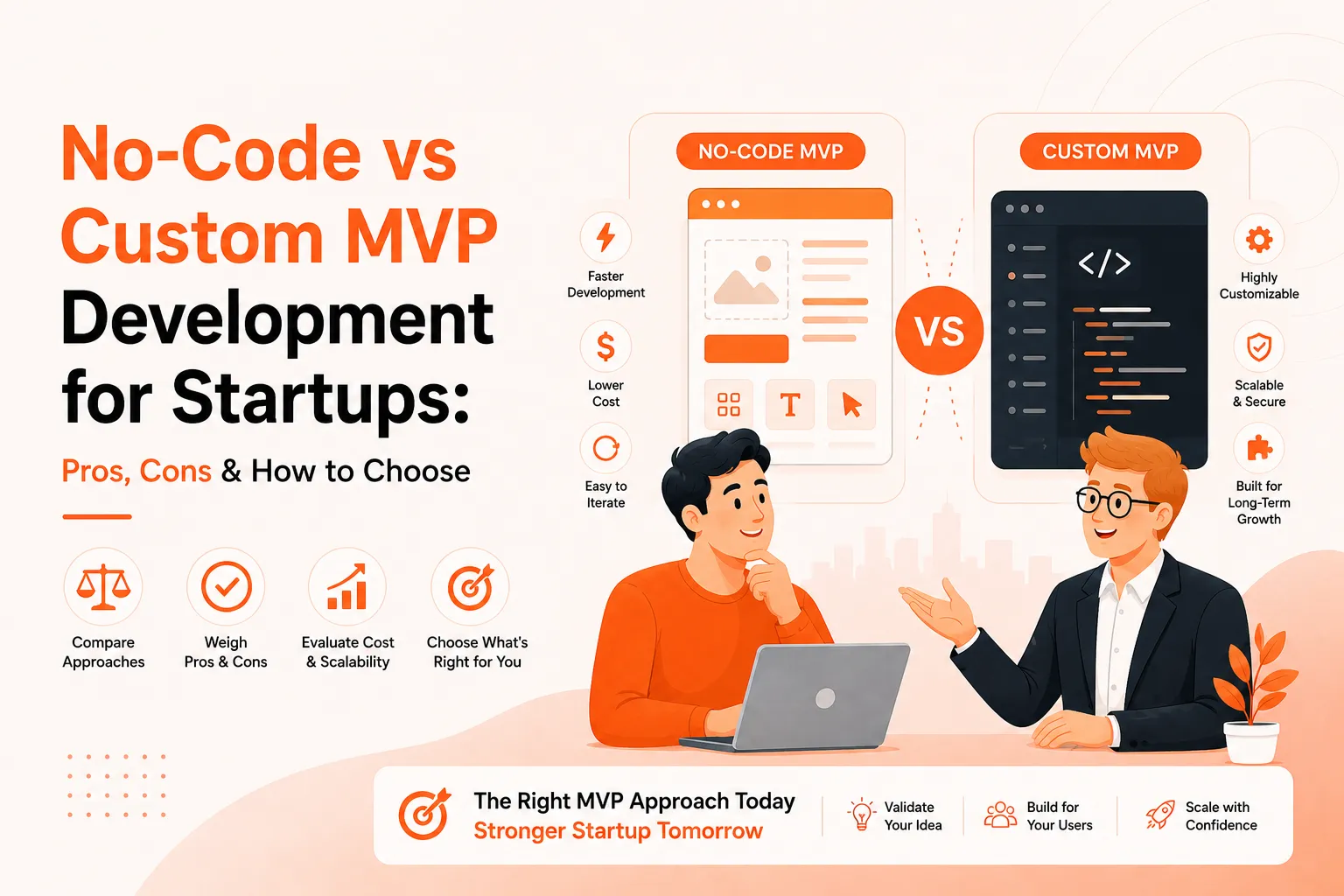
Startups often choose between no-code and custom MVP development when building their first product. No-code MVPs help launch faster with lower costs, while custom MVP development offers better scalability, flexibility, and long-term growth. The right choice depends on your startup goals, budget, timeline, product complexity, and plans.
Understanding MVP Development for Startups
Every startup begins with an idea. But turning that idea into a real product requires time, money, and smart planning. This is where MVP development for startups becomes important.
An MVP, or Minimum Viable Product, is a basic version of a product built with only the core features. It helps startups test their idea in the market before investing heavily in full-scale development.
Today, startups usually choose between two popular approaches:
-
No-code MVP development
-
Custom MVP development
Both options have advantages and limitations. Some startups need speed and lower costs, while others need scalability and flexibility from the start.
Choosing the wrong approach can create future problems related to performance, user experience, integrations, and growth. That is why understanding the difference between no-code and custom MVP development is important before building your product.
In this guide, you will learn how both approaches work, their pros and cons, and which one is better for your startup.
Why MVP Validation Matters for Startups
Building an MVP helps startups validate product-market fit before investing heavily in full-scale development. This is important because many startups fail due to launching products without validating real market demand.
According to CB Insights Research, poor product-market fit remains one of the biggest reasons startups fail. Their analysis of startup post-mortems found that many companies struggled because they built products users did not actually need.
This is one reason why MVP development for startups has become an important strategy. Whether using no-code or custom development, startups can test ideas early, collect user feedback, and reduce long-term business risks.
What Is No-Code MVP Development?
No-code MVP development allows startups to build applications without traditional programming. Instead of writing code, users build products using visual editors, drag-and-drop components, and automation tools.
Popular no-code platforms include Bubble, Webflow, Glide, Adalo, and Zapier.
This approach is becoming popular among early-stage startups because it reduces development time and technical complexity.
How No-Code MVP Development Works
No-code platforms provide ready-made tools and templates. Founders can create pages, workflows, forms, databases, and automations visually.
For example, instead of coding a login system manually, startups can use built-in authentication features available inside the platform.
Most no-code tools also support integrations with payment gateways, CRMs, email tools, and analytics platforms.
This allows startups to launch products quickly without hiring a full development team.
Benefits of No-Code MVP Development
Faster Product Launch
One of the biggest advantages of a no-code MVP for startups is speed.
A product that may take months with traditional coding can often be built within days or weeks using no-code tools.
This helps startups validate ideas quickly.
Lower Initial Development Cost
Custom development can be expensive for early-stage businesses.
No-code platforms reduce the need for large engineering teams, making startup MVP development more affordable.
Using an efficient development process is important for reducing delays and improving product quality. Many startups now follow Agile Methodology for MVP Success to build, test, and improve their MVPs through continuous iteration and faster feedback cycles.
This is especially useful for founders working with limited budgets.
Easier Testing and Iteration
Startups usually change features based on user feedback.
No-code platforms make it easier to update workflows, designs, and product features without rebuilding the entire application.
Ideal for Non-Technical Founders
Not every founder has a technical background.
No-code tools allow business owners and startup teams to create functional products without advanced coding knowledge.
Growing Adoption of No-Code Development
No-code development is growing rapidly because startups want faster product launches and lower development costs.
According to The Economic Times Report on AI and No-Code MVPs, many founders are now using platforms like Bubble, Glide, Webflow, and AI-powered tools to launch MVPs within days instead of months. This trend is helping non-technical founders enter the startup ecosystem more easily.
Limitations of No-Code Platforms
Limited Customization
No-code platforms work within predefined structures.
If your startup requires unique features or advanced workflows, customization may become difficult.
Scalability Challenges
As your product grows, no-code systems may struggle with large user bases or complex operations. Some platforms also have database and performance limitations.
Integration Restrictions
While many integrations are available, not every tool or API is supported.
Complex third-party integrations can become difficult over time.
Platform Dependency
With no-code tools, startups depend on the platform provider. Pricing changes, feature limitations, or platform shutdowns can affect your business later.
What Is Custom MVP Development?
Custom MVP development involves building a product from scratch using programming languages, frameworks, and dedicated development teams.
Unlike no-code platforms, custom development provides complete control over product architecture, design, and functionality.
This approach is often used by startups planning long-term growth and advanced product functionality.
How Custom MVP Development Works
Developers create the application using technologies like React, Node.js, Python, Laravel, Flutter, or other frameworks.
The development process usually includes:
-
Product planning
-
UI/UX design
-
Backend development
-
Frontend development
-
Database setup
-
Testing and deployment
Every feature is developed specifically for the startup’s needs.
This creates more flexibility and better control over the product.
Advantages of Custom MVP Development
Full Flexibility
Custom MVP development services allow startups to build exactly what they need.
There are no platform restrictions.
You can add custom workflows, features, dashboards, or integrations anytime.
Better Scalability
Custom-built products can handle growth more effectively.
As users increase, developers can optimize infrastructure and performance accordingly.
This makes custom development a strong choice for scalable MVP solutions.
Stronger Security
Security becomes important when handling user data, payments, or sensitive information.
Custom applications offer better control over security practices and compliance requirements.
Better User Experience
Custom products provide more freedom in design and user experience.
Startups can create unique interfaces tailored to their audience.
Challenges of Custom MVP Development
Higher Development Cost
Custom development usually requires developers, designers, testers, and project managers.
This increases the initial investment.
Longer Development Timeline
Building from scratch takes more time compared to no-code platforms.
Complex products may require several months for launch.
Technical Expertise Required
Startups need experienced developers or a reliable development partner. Managing technical teams can also become challenging for non-technical founders.
No-Code vs Custom MVP Development: Key Differences
Understanding the main differences helps startups choose the right approach based on their goals.
|
Factor
|
No-Code MVP Development
|
Custom MVP Development
|
|
Development Speed
|
Faster launch within days or weeks
|
Longer development timeline
|
|
Initial Cost
|
Lower upfront investment
|
Higher upfront development cost
|
|
Scalability
|
Limited for complex scaling
|
Highly scalable architecture
|
|
Customization
|
Limited platform flexibility
|
Full customization available
|
|
Performance
|
Suitable for basic applications
|
Better for high-performance products
|
|
Ownership
|
Platform dependent
|
Full code ownership
|
|
Technical Skills
|
Minimal technical knowledge needed
|
Requires developers and engineers
|
|
Maintenance
|
Easier platform-managed maintenance
|
Requires dedicated maintenance and updates
|
|
Best For
|
Early validation and simple apps
|
Long-term scalable startups
|
|
Examples
|
Bubble, Glide, Webflow, Adalo
|
React, Node.js, Laravel, Flutter
|
Development Speed Comparison
No-code development is much faster.
Founders can launch simple products within a few weeks.
Custom MVP development takes longer because everything is built from scratch.
However, the extra time often results in better product quality and flexibility.
MVP Development Cost Comparison
No-code solutions are cheaper initially.
They reduce development costs and allow startups to validate ideas without major investment.
Custom MVP development costs more upfront due to engineering resources and technical work.
But in the long term, custom products may become more cost-effective for scaling businesses.
Scalability and Performance
No-code tools work well for small and medium-sized applications.
But performance issues may appear as traffic and features grow.
Custom applications offer stronger scalability, faster performance, and better infrastructure management.
This is important for startups expecting rapid growth.
Flexibility and Customization
No-code tools have feature limitations.
Custom development gives complete freedom over functionality, workflows, and integrations.
If your product idea is unique or technically complex, custom development is usually the better option.
Maintenance and Ownership
With no-code tools, the platform controls infrastructure and updates.
With custom development, startups fully own the codebase and technology stack.
This provides more independence and long-term control.
Which MVP Development Approach Is Best for Startups?
There is no single answer for every startup. The right approach depends on your product goals, budget, technical requirements, launch timeline, and long-term growth plans.
When to Choose No-Code MVP Development
No-code MVP development is suitable when:
-
You want to validate an idea quickly
-
Your budget is limited
-
Your product is simple
-
You need rapid MVP development
-
You are a non-technical founder
It works best for marketplaces, internal tools, landing pages, booking systems, and simple SaaS products.
Example: When No-Code Makes Sense
A founder building a local marketplace can use platforms like Bubble or Glide to test customer demand within a few weeks. This allows the startup to launch quickly, collect user feedback, and validate the business idea with minimal investment. If the product gains traction, the startup can later migrate to a custom-built platform for better scalability and advanced functionality.
When to Choose Custom MVP Development
Custom MVP development is better when:
-
Your product requires advanced functionality
-
You expect high user growth
-
Security is important
-
Your startup needs complex integrations
-
You want complete ownership and flexibility
This approach is common for fintech, healthcare, AI platforms, enterprise software, and scalable SaaS products.
Example: When Custom Development Makes Sense
A fintech startup handling online payments and sensitive financial data typically requires custom MVP development because of strict security requirements, compliance standards, and complex third-party integrations. A custom-built solution provides greater control over infrastructure, scalability, and data protection.
Hybrid Approach for Startups
Many startups now use a hybrid strategy.
They start with a no-code MVP to test market demand quickly.
Once the product gains traction, they move to custom development for scalability and advanced functionality.
This approach reduces initial risk while supporting future growth.
Common Mistakes Startups Make When Choosing MVP Development
Choosing the wrong MVP development approach can create long-term challenges for startups. Many founders focus only on short-term speed or cost without considering future product requirements and scalability.
Some of the most common mistakes include:
-
Choosing no-code platforms for highly complex or technically demanding products
-
Investing heavily in custom development before validating market demand
-
Ignoring future scalability and performance requirements
-
Making decisions based only on development cost instead of long-term value
-
Building too many features instead of focusing on core MVP functionality
-
Underestimating the importance of user feedback and iteration during early development
-
Selecting tools or technologies that limit future integrations and customization
Avoiding these mistakes can help startups launch faster, reduce unnecessary development costs, and build a stronger foundation for future product growth. The most effective MVP strategies focus on validating the core idea first while keeping scalability and long-term business goals in mind.
Choosing the Right MVP Strategy for Long-Term Growth
Startups should not only think about launch speed.
They should also consider future product expansion.
Before choosing between no-code and custom MVP development, ask these questions:
-
How complex is the product idea?
-
How fast do you need to launch?
-
What is your current budget?
-
Will the product require scaling soon?
-
Do you need advanced integrations?
-
How important is long-term flexibility?
Answering these questions helps startups make better development decisions.
A simple MVP today may become a large platform tomorrow.
That is why balancing short-term speed with long-term scalability is important.
Frequently Asked Questions
What is the difference between no-code and custom MVP development?
No-code MVP development uses visual platforms and drag-and-drop tools to build products quickly without coding. Custom MVP development involves building applications from scratch using programming languages and frameworks.
Is no-code development suitable for SaaS startups?
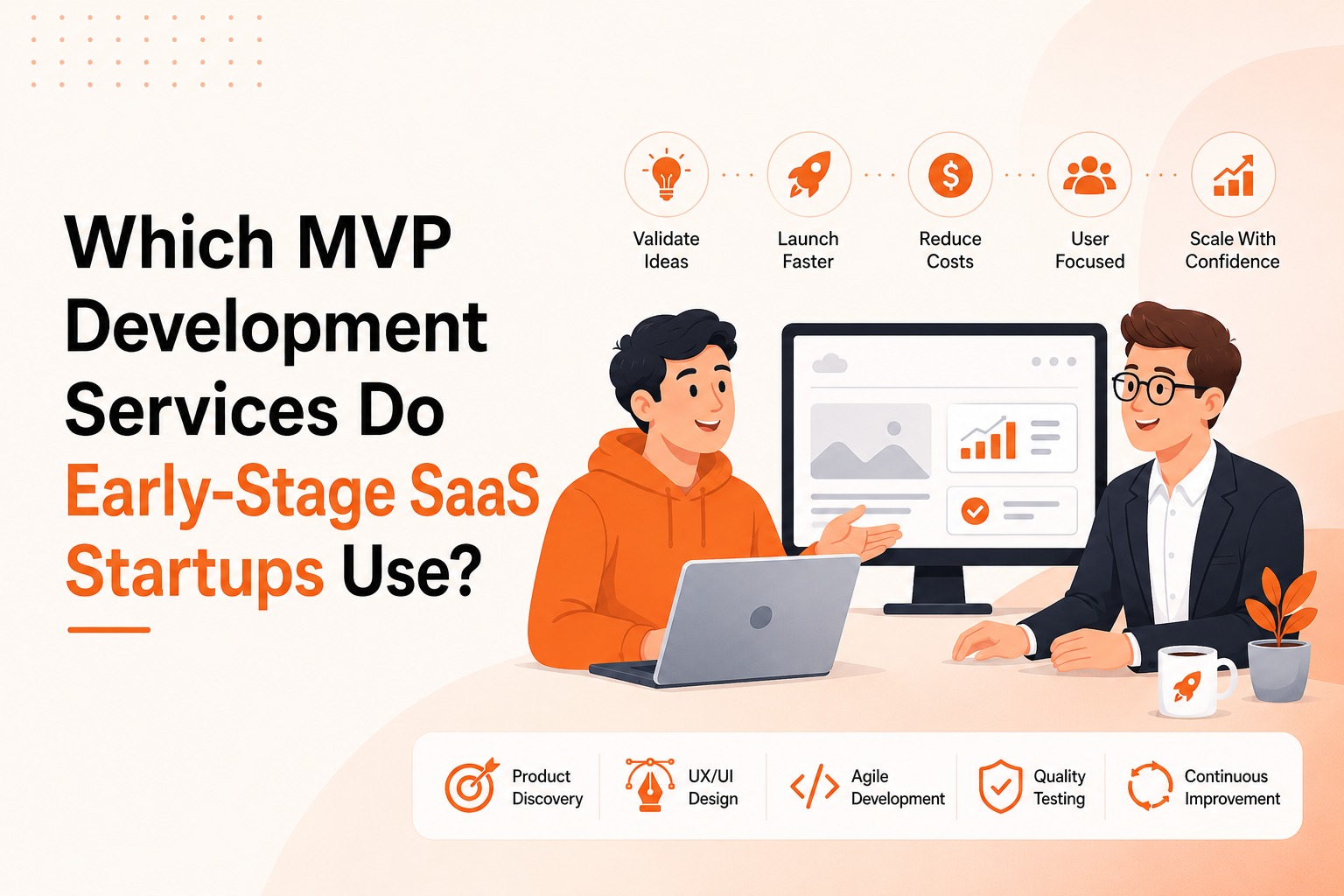
Yes, no-code development can be a strong option for SaaS startups in the early stages. It allows founders to launch faster, validate business ideas, test user demand, and reduce initial development costs without building a full engineering team. However, as the SaaS product grows and requires advanced features, scalability, complex integrations, or stronger customization, many startups eventually transition to custom development.
Why do startups choose custom MVP development?
Startups choose custom MVP development for better scalability, flexibility, advanced functionality, stronger security, and complete ownership of the product.
Which is cheaper: no-code or custom MVP development?
No-code MVPs are generally cheaper in the beginning because they require fewer technical resources. Custom MVPs involve higher upfront costs but may offer better long-term scalability.
Can startups switch from no-code to custom development later?
Yes, many startups start with no-code tools for early validation and later move to custom development as their product grows.
How long does it take to build a custom MVP?
Custom MVP development usually takes several weeks to several months depending on the complexity, features, integrations, and development team size.
Important Questions Startups Should Ask Before Building an MVP
Before choosing between no-code and custom MVP development, startups should evaluate:
-
How quickly does the product need to launch?
-
Will the product require advanced scaling later?
-
Is long-term flexibility important?
-
How complex are the core features?
-
What is the available development budget?
-
Will the product require custom integrations or security compliance?
Answering these questions early can help startups avoid rebuilding products later and reduce development costs.
Build the Right MVP for Your Startup
Choosing between no-code and custom MVP development is not just about development speed or cost. It is about building the right foundation for your startup’s future growth.
Some startups need a fast MVP for idea validation, while others require scalable architecture and advanced product flexibility from the beginning.
While no-code platforms are excellent for rapid validation, custom MVP development remains the preferred choice for startups building products that require scalability, advanced functionality, stronger security, and long-term ownership.
The best choice depends on your startup vision, budget, timeline, and technical requirements. Before starting development, focus on your business goals first. A smart MVP strategy can save time, reduce costs, and help your startup grow more efficiently.
If you are planning MVP development for startups, take time to evaluate both approaches carefully and choose the one that supports your long-term product success. Need help choosing between no-code and custom MVP development? Multisyn Tech helps startups build scalable MVPs that align with their goals, budget, and growth plans.