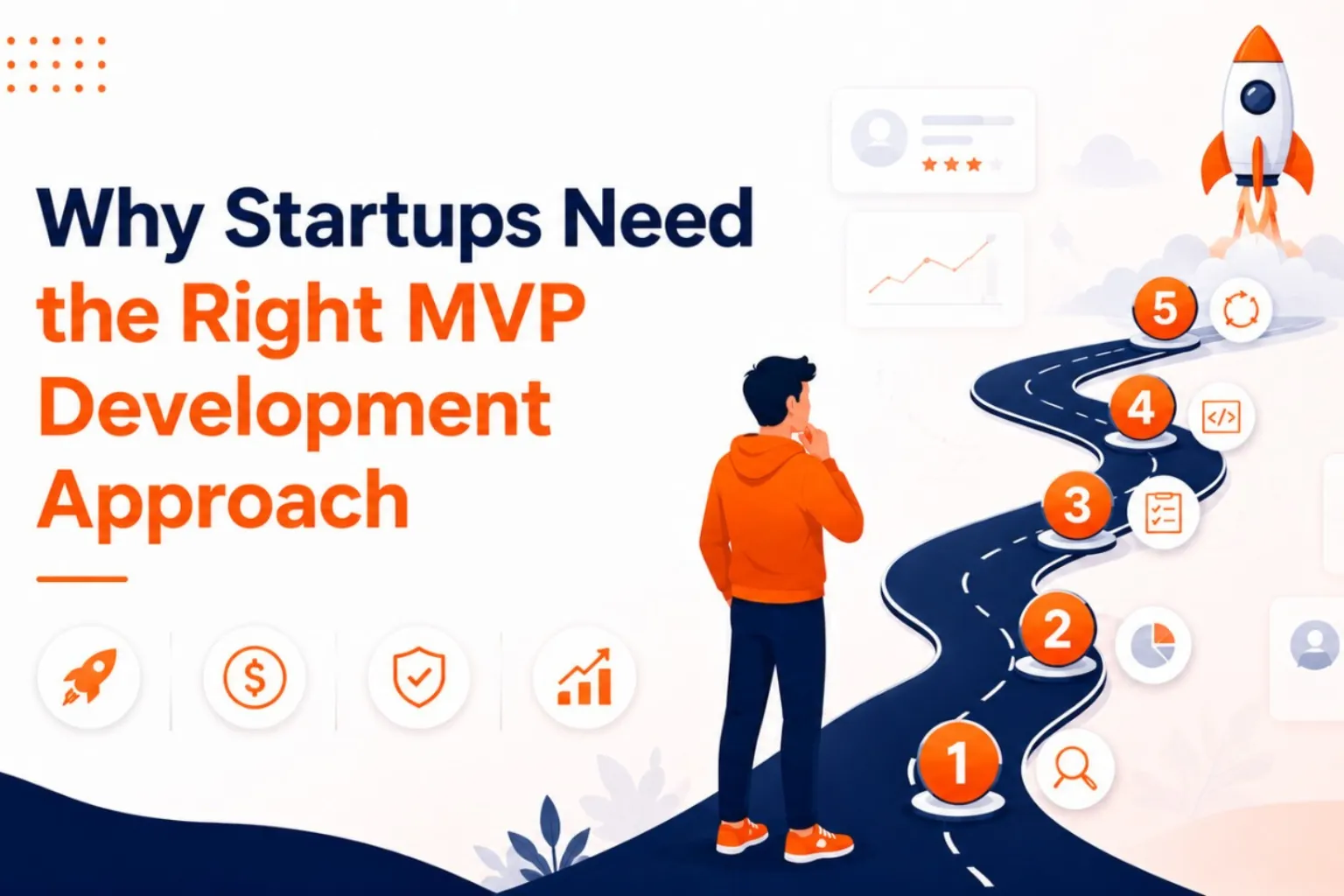
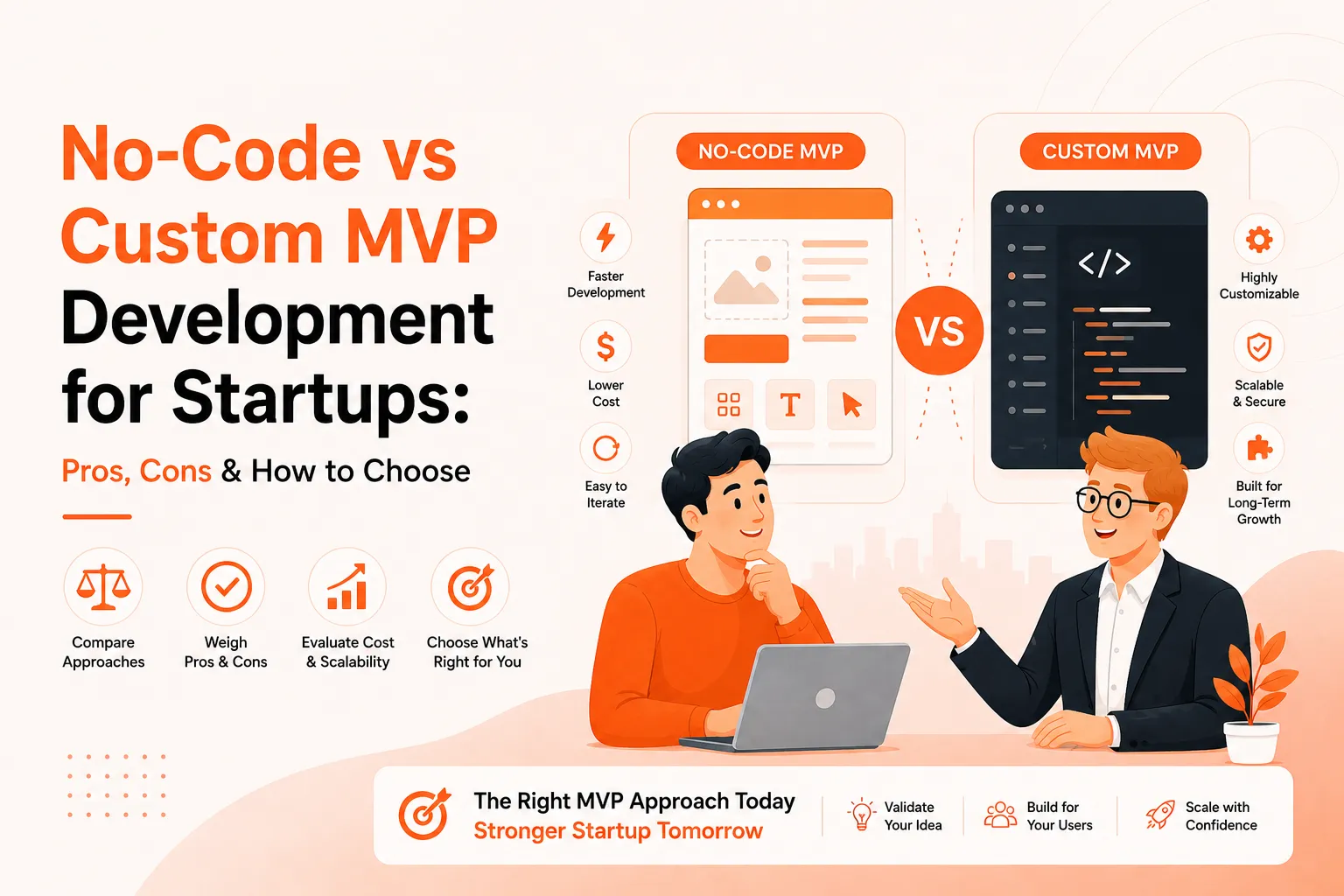
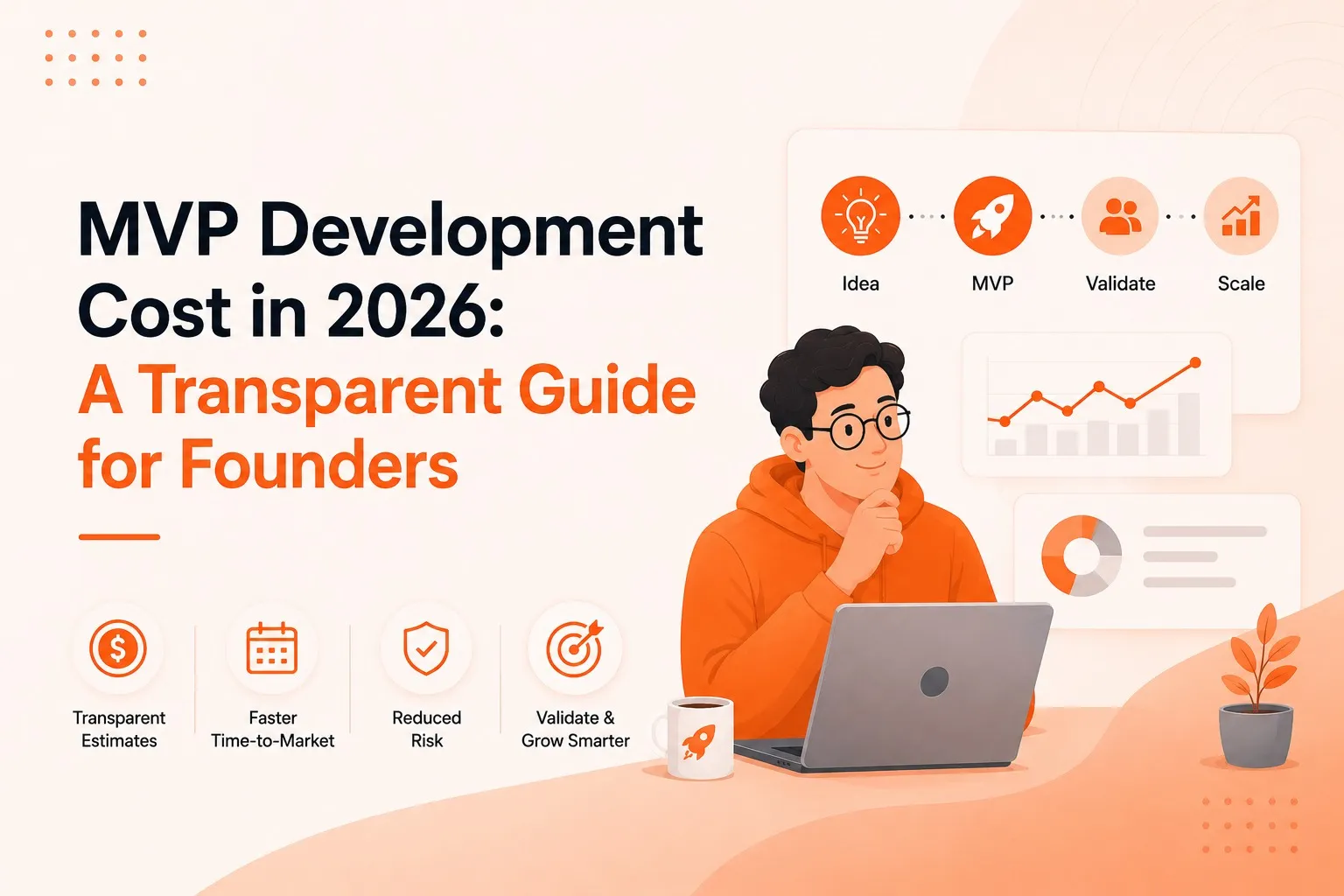
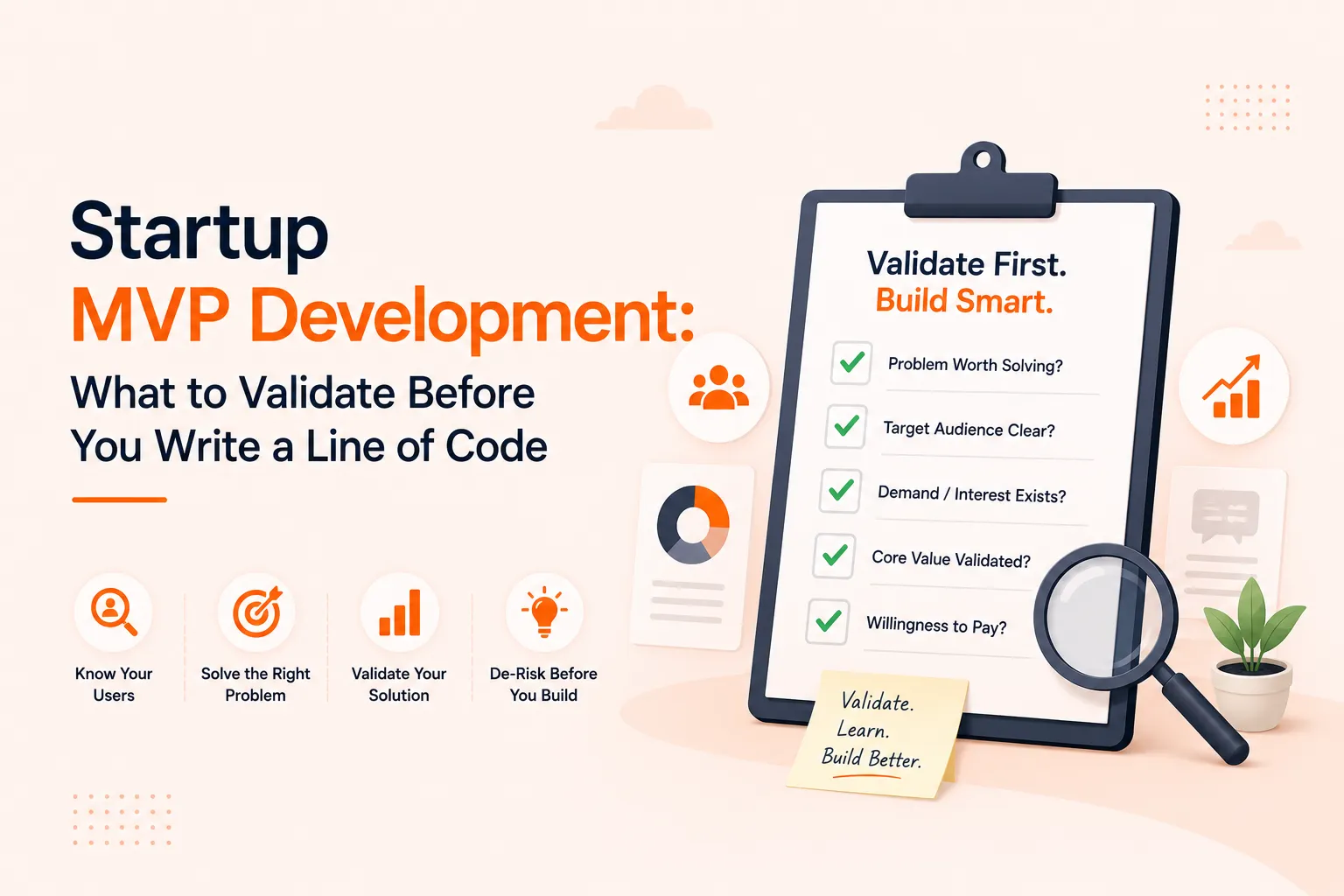
Building the wrong product is one of the fastest ways for a startup to burn through its runway. Surprisingly, the problem isn't poor development. It's choosing the wrong MVP development approach. The right MVP development approach helps startups test ideas early, reduce risks, collect real user feedback, and launch faster. Instead of creating a fully-featured product from day one, startups can focus on core features, validate demand, and improve the product step by step based on market response.
What Is MVP Development for Startups?
An MVP, or Minimum Viable Product, is the first working version of a product with only the essential features. It is built to solve a core problem for users while allowing startups to test their idea in the real market.
The goal of MVP development is not to launch a perfect product. The goal is to learn quickly.
Many startups believe they need a complete product before entering the market. In reality, successful companies like Airbnb and Dropbox often started with simple MVPs that evolved over time through user feedback and testing.
An MVP helps startups:
Simply building an MVP isn't enough. The real difference lies in how you approach MVP development, because the wrong strategy can waste just as much time and money as building a full product.
Why the Right MVP Development Approach Matters
Building an MVP is not only about creating a basic product. The approach behind it matters even more.
A poor MVP strategy can waste time, confuse users, and create technical problems later. On the other hand, the right MVP development approach helps startups move in the right direction from the beginning.
Reducing Startup Risks and Costs
One of the biggest reasons startups fail is overspending before validating the product idea.
Without proper planning, startups may invest heavily in features users never wanted. A structured MVP approach allows businesses to focus only on high-priority features first.
This reduces:
Instead of spending months building everything at once, startups can release a simple version and test the market response early.
Faster Product Validation
Product validation is critical for startups.
An MVP helps founders understand whether people are interested in the product before scaling it further.
With a proper MVP development process, startups can:
-
Test real user demand
-
Identify product-market fit
-
Collect customer feedback
-
Improve weak areas quickly
This feedback becomes valuable for future product decisions.
Speeding Up Time-to-Market
Startups operate in competitive markets where timing matters.
Launching too late can mean losing opportunities to competitors. The right MVP strategy helps startups release products faster without sacrificing the main user experience.
Early launches allow businesses to:
For startups exploring agile product delivery, Agile development practices provide useful guidance on iterative development and continuous improvement.
Validation-First MVP vs. Feature-First MVP
Understanding why the MVP Development Approach matters is only the first step. The next question is how successful startups actually approach MVP development. While many founders aim to launch quickly, not every MVP is built with the same mindset.
Some focus on validating assumptions before writing code, while others prioritize building as many features as possible. The difference between these approaches often determines whether a startup learns quickly or wastes valuable time and resources.
|
Validation-First MVP
|
Feature-First MVP
|
|
Starts by validating the customer's problem
|
Starts by building a list of features
|
|
Focuses on one core value proposition
|
Attempts to solve multiple problems at once
|
|
Launches quickly to gather user feedback
|
Delays launch until the product feels "complete"
|
|
Product decisions are based on customer evidence
|
Product decisions are based on assumptions
|
|
Lower development costs and less rework
|
Higher upfront costs and frequent redesigns
|
|
Easier to pivot when feedback changes direction
|
More difficult and expensive to make changes
|
|
Improves product-market fit through continuous iteration
|
Risks of building features users may never use
|
|
Best suited for early-stage startups
|
Better suited for mature products with validated demand
|
The comparison highlights an important reality: successful MVPs aren't defined by how many features they include but by the decisions made before development begins. Unfortunately, many startups still take a feature-first approach, investing heavily in assumptions instead of validating customer needs. As a result, they often encounter avoidable challenges long before their product has a chance to gain traction.
Why Most Startup MVPs Fail Before They Launch
Building an MVP doesn't automatically mean you're building the right product. Many startup MVPs fail before they ever gain traction—not because of poor development, but because founders start building before validating whether the problem is worth solving.
According to CB Insights, 35% of startups fail because there is no market need for their product, making it the most common reason startups fail. The takeaway is simple: building efficiently doesn't matter if you're building the wrong solution.
Common Mistakes Founders Make
Many early-stage startups fall into the same traps:
-
Starting development before validation instead of confirming that customers actually need the solution.
-
Building based on assumptions rather than insights gathered from real users.
-
Adding too many features in an attempt to impress users instead of solving one core problem.
-
Hiring a development team too early can lead to costly rework if the idea changes.
-
Skipping customer interviews and market research results in products that don't address real user needs.
Individually, these mistakes may seem small. Together, they can consume months of development time and a significant portion of a startup's runway before the product ever reaches the right audience.
A Simple Example
One of the most common startup mistakes follows the same pattern: the decision to build first and validate later. Founders invest months of development time and tens of thousands of dollars into a polished product with every planned feature. The mistake isn't poor engineering—it's skipping market validation. The consequence is a launch that attracts little traction, weak customer engagement, and an expensive lesson that could have been avoided with an MVP.
The problem isn't the quality of the product: it's that customer demand was never validated before development began.
Successful startups don't avoid failure because they write better code. They succeed because they validate problems first, learn from real users, and let evidence, not excitement, guide what they build.
Fortunately, these mistakes are avoidable. A structured MVP development approach gives founders a practical roadmap for validating ideas before making larger investments.
The 5 Stages of an Effective MVP Approach to Product Development
An MVP isn't a single milestone. It's a sequence of decisions. Founders who consistently build successful products don't jump straight into development. They reduce uncertainty one step at a time, validating assumptions before investing more time and money.
The following framework reflects how many experienced startup teams approach MVP development for startups. Each stage builds on the previous one, ensuring you're learning before you're scaling.
1. Validate the Problem Before Building the Solution
Every startup begins with an assumption: people have a problem worth solving. The first objective isn't to prove your product is great. It's to prove the problem actually exists.
Before planning features or hiring developers, ask yourself:
-
Is this a real problem or just an interesting idea?
-
Who experiences it most often?
-
How are people solving it today?
-
Is the problem painful enough that they'll actively seek a better solution?
The answers shouldn't come from brainstorming sessions. They should come from potential customers.
The fastest way to validate a problem is to speak with the people experiencing it. Customer interviews often reveal insights that surveys can't. Community discussions on Reddit or Quora can highlight recurring pain points, while a simple landing page or waitlist helps measure whether people are interested enough to take action.
Founder Insight: One customer interview that changes your roadmap is more valuable than a month spent building features nobody requested.
2. Validate the Market, Not Just the Idea
Even if you've identified a genuine customer problem, there's another question to answer:
Is there a market for this solution?
Market validation goes beyond checking whether competitors exist. It helps you understand where your product fits and whether customers are willing to adopt or pay for it.
Focus on answering questions like:
-
Who are your direct and indirect competitors?
-
What makes your solution different?
-
Are customers already spending money to solve this problem?
-
Is demand growing or declining?
Competition isn't necessarily a warning sign. In many cases, it's evidence that customers recognize the problem and are willing to invest in solutions. Your goal is to identify the gap your product can fill, not to create a market from scratch.
3. Prioritize Features That Maximize Learning
Once you've validated both the problem and the market, it's time to decide what belongs in your MVP.
This is where many startups lose focus.
Instead of asking, "What features can we build?", ask:
"What is the smallest product that will help us validate our biggest assumption?"
You can follow the RICE framework (Reach, Impact, Confidence, and Effort) to prioritize features objectively instead of relying on intuition.
Founder Tip: Every feature you add delays your next learning opportunity.
Remember, every additional feature increases development time, complexity, and cost. Your first release isn't meant to satisfy every customer; it's meant to answer your most important business question.
4. Choose the Fastest Path to Validation
Once you've decided what to build, choose the development approach that helps you validate your idea as quickly and efficiently as possible.
The right choice depends on your product, budget, and stage of validation.
-
No-code platforms are ideal when you want to test an idea quickly without writing code.
-
Low-code solutions work well when you need greater flexibility while maintaining faster development.
-
Custom MVP development becomes a better option when your product requires complex functionality, scalability, or unique user experiences.
Instead of asking, "What's the best technology?", ask:
"What's the fastest way to learn whether this idea deserves further investment?"
Technology should support validation, not become the project itself.
Reality Check: Delaying launch doesn't reduce risk. It often delays discovering the risks that matter most.
5. Measure, Learn, and Iterate
Many founders see launch day as the finish line. In reality, it's the beginning of the most valuable stage of the entire MVP journey.
Once your product is in users' hands, your objective shifts from building to learning.
Don't try to track dozens of KPIs after launch. Focus on a handful of metrics that reveal whether users are receiving value from your product. Activation, retention, feature adoption, customer feedback, and revenue are usually enough to guide early product decisions.
These insights tell you what users value, where they struggle, and what deserves your next investment.
Launching an MVP isn't about proving you were right. It's about discovering what you still need to learn.
Practical Advice: Resist the urge to build new features after every piece of feedback. Look for patterns across multiple users before changing your roadmap. One request is an opinion; repeated requests reveal a genuine market need.
These five stages aren't just theoretical. They reflect how many successful startups approached product development before becoming household names.
What Founders Can Learn from Successful Startup MVPs
Some of the world's most successful startups didn't begin with polished products or large development teams. They started with simple experiments designed to answer one important question: Will people actually use this?
Instead of investing heavily in development, they validated demand first and expanded only after they had evidence that their idea solved a real problem.
|
Startup
|
How They Validated Their Idea
|
What Founders Should Learn
|
|
Airbnb
|
The founders rented out air mattresses in their apartment to conference attendees before building a full marketplace.
|
Validate customer demand before investing in technology. If people won't pay for a simple version of your solution, adding more features won't create demand.
|
|
Dropbox
|
Before developing the product, Dropbox released a short demo video explaining how it would work. The video generated thousands of sign-ups and proved there was genuine interest.
|
Test interest before writing code. Landing pages, explainer videos, and prototypes can validate demand faster and at a fraction of the cost of full development
|
|
Instagram
|
Instagram launched with a simple photo-sharing experience instead of the many features users know today. The team expanded the product gradually based on user behavior and feedback.
|
Start with one core use case instead of solving every customer problem. A focused product creates clearer feedback and faster product-market fit.
|
The Common Pattern
Although these startups solved different problems, they all followed the same principle: validate first, scale later.
They didn't try to build everything at once. Instead, they tested one core idea, learned from early users, and used those insights to guide future development. That's the real value of a successful MVP development approach.
Before investing significant time or money, ask yourself one question:
What is the single biggest uncertainty in my business, and what is the fastest way to validate it?
The answer to that question should shape your MVP.
While the principles remain the same, executing them effectively often depends on having the right expertise and development process in place.
How the Right Minimum Viable Product Development Services Save Time, Money, and Runway
For early-stage startups, every development decision affects your budget, timeline, and ability to grow. The right minimum viable product development services go beyond building software, they help you validate your idea, prioritize the right features, and invest your resources where they matter most.
According to Startup Genome, startups that scale too early are significantly more likely to fail because they invest in growth before validating market demand. The right MVP development partner helps you avoid that mistake by focusing on learning before scaling.
Key Benefits of the Right MVP Development Services for Startups
The value of professional MVP development services isn't simply writing code faster. An experienced team helps founders make better product decisions before expensive development begins.
Reduce Costly Development Mistakes
By validating ideas before full-scale development, you avoid spending time and money on features that users don't need. This leads to fewer revisions, lower development costs, and a more focused product roadmap.
Launch Faster and Improve Continuously
A lean MVP inspired by the Lean Startup methodology gets your product into users' hands sooner, allowing you to collect real-world insights and make incremental improvements instead of waiting months for a perfect release.
Prevent Unnecessary Technical Debt
Building only the features that deliver value keeps your product simpler, easier to maintain, and more scalable as your startup grows.
Build Stronger Investor Confidence
Investors want evidence that your idea has market potential. Early user adoption, waitlists, engagement metrics, and customer validation demonstrate traction far better than a long list of unfinished features.
Preserve Your Startup Runway
Every unnecessary month of development consumes valuable runway. A validation-first approach helps you make smarter investments, extend your budget, and reduce the likelihood of expensive pivots later.
Even with the right strategy and development partner, timing matters. Before you begin building, make sure your startup is actually ready for an MVP.
Signs You're Ready to Build an MVP for Your Startup
Many founders rush into development because they have an exciting idea. The problem is that ideas alone rarely lead to successful products. Before investing time and money in building, make sure you've validated the fundamentals.
Use this quick checklist to see whether you're ready to move from idea to MVP development.
MVP Readiness Checklist
|
Question
|
Ready?
|
|
✓ You clearly understand the customer problem you're solving.
|
☐
|
|
✓ You've interviewed or spoken with potential users to validate the problem.
|
☐
|
|
✓ You know exactly who your target audience is.
|
☐
|
|
✓ You can describe your value proposition in one simple sentence.
|
☐
|
|
✓ One core feature addresses the biggest customer pain point.
|
☐
|
|
✓ People have shown genuine interest by signing up, joining a waitlist, requesting a demo, or agreeing to test the product.
|
☐
|
|
✓ You know what success metrics you'll measure after launch (activation, retention, feedback, or conversions).
|
☐
|
|
✓ You've prioritized learning over building every feature.
|
☐
|
Rule of thumb: If you can confidently check 6–8 boxes, you're likely ready to begin MVP development. If you check fewer than six, spend more time validating your assumptions before writing code.
Passing the readiness checklist means you've reduced much of the uncertainty around your idea. Now it's time to focus on execution by selecting an MVP development partner who understands how to build, validate, and iterate with startups.
How Startups Can Choose the Right MVP Development Partner
For many startups, working with an experienced MVP development team can simplify the process.
Choosing the right partner matters because development decisions affect product quality, scalability, and future growth.
Look for Startup Experience
A development team with startup experience understands:
They can guide startups through the MVP process more effectively.
Focus on Communication
Clear communication is important during development.
The team should provide:
-
Regular updates
-
Transparent timelines
-
Technical guidance
-
Feedback support
Strong collaboration leads to better results.
Check Technical Expertise
The development team should understand:
Technical flexibility helps startups grow their products smoothly.
Review Past MVP Projects
Looking at previous projects can help startups understand:
-
Product quality
-
Industry experience
-
Design approach
-
Development capabilities
A strong portfolio usually reflects better expertise.
Final Thoughts
The most successful startups aren't the ones that build the fastest. They're the ones who validate and learn the fastest.
The right MVP development approach isn't about creating less software; it's about reducing uncertainty before making larger investments. Every customer interview, prototype, and product iteration helps validate assumptions before significant time and capital are committed.
Founders who focus on solving one meaningful problem, gather real user feedback early, and iterate based on data rather than opinions are far more likely to achieve product-market fit while conserving valuable runway. An MVP isn't the finish line—it's the starting point for building a product people genuinely want.
The goal isn't to launch with the most features. It's to reduce uncertainty faster than your competitors. Founders who validate continuously make better product decisions, preserve more runway, and reach product-market fit with far fewer expensive mistakes.
Frequently Asked Questions
What is MVP development for startups?
MVP development for startups is the process of building the simplest version of a product that solves a core problem and allows founders to validate demand with real users. The goal is to gather feedback, test assumptions, and reduce risk before investing in full-scale product development.
How long does MVP development for startups typically take?
Most MVPs launch within 6 to 12 weeks when the scope is focused on core functionality. More complex products involving custom integrations, AI capabilities, or advanced workflows may take 3 to 6 months. In most cases, delays are caused by expanding the scope rather than technical challenges.
What is the best MVP development approach?
The best MVP Development Approach focuses on validating assumptions before scaling. It involves identifying the riskiest hypothesis, building only essential features, launching early, measuring user behavior, and improving the product based on real feedback rather than internal opinions.
How much does MVP development cost for a startup?
The cost of MVP development typically ranges from $15,000 to $150,000, depending on complexity, feature requirements, development team structure, and technology choices. A focused MVP usually costs far less than building a full product and helps prevent expensive rework later.
Should founders build with no-code first?
It depends on the product and your goals. No-code is a good option for validating simple ideas, testing demand, and collecting user feedback quickly with minimal investment. If your product requires custom functionality, scalability, complex integrations, or strong security, custom MVP development is usually the better long-term choice.
When should a startup hire an MVP development company?
A startup should hire an MVP development company when the idea has been validated, the target audience is defined, and the founder is ready to build a market-ready product. An experienced development partner can help prioritize features, reduce technical risk, accelerate launch, and create a scalable foundation for future growth.
Can an MVP attract investors?
Yes. A well-executed MVP can make a startup more attractive to investors by demonstrating market demand, validating the core problem, and providing early user feedback or traction. While an MVP alone doesn't guarantee funding, it shows that founders can test assumptions, execute efficiently, and make data-driven decisions before scaling.
What comes after launching an MVP?
Launching an MVP is only the beginning. After release, startups should analyze user behavior, collect customer feedback, identify which features create the most value, and improve the product through continuous iterations. The goal is to achieve product-market fit before investing in large-scale development or growth.
Build Smarter Before Scaling Bigger
Successful startups do not begin with perfect products. They begin with smart decisions, focused development, and continuous improvements.
The right MVP development approach helps startups launch faster, reduce unnecessary costs, validate ideas, and build products based on real user needs. Instead of investing heavily in assumptions, businesses can test, learn, and grow step by step.
A clear MVP strategy also creates a stronger foundation for future scalability and long-term product success.
Ready to Turn Your Startup Idea Into a Working MVP?
Whether you are launching a SaaS platform, mobile app, or digital marketplace, starting with the right MVP strategy can save time, reduce costs, and improve your chances of success. Explore Multisyn Tech professional MVP development services to build a scalable product that aligns with your startup goals and market needs.
Whether you're launching a SaaS platform, mobile app, or digital marketplace, starting with the right MVP strategy can save time, reduce costs, and improve your chances of success. If you need expert guidance, experienced MVP development services can help you turn your idea into a scalable product based on real market feedback.