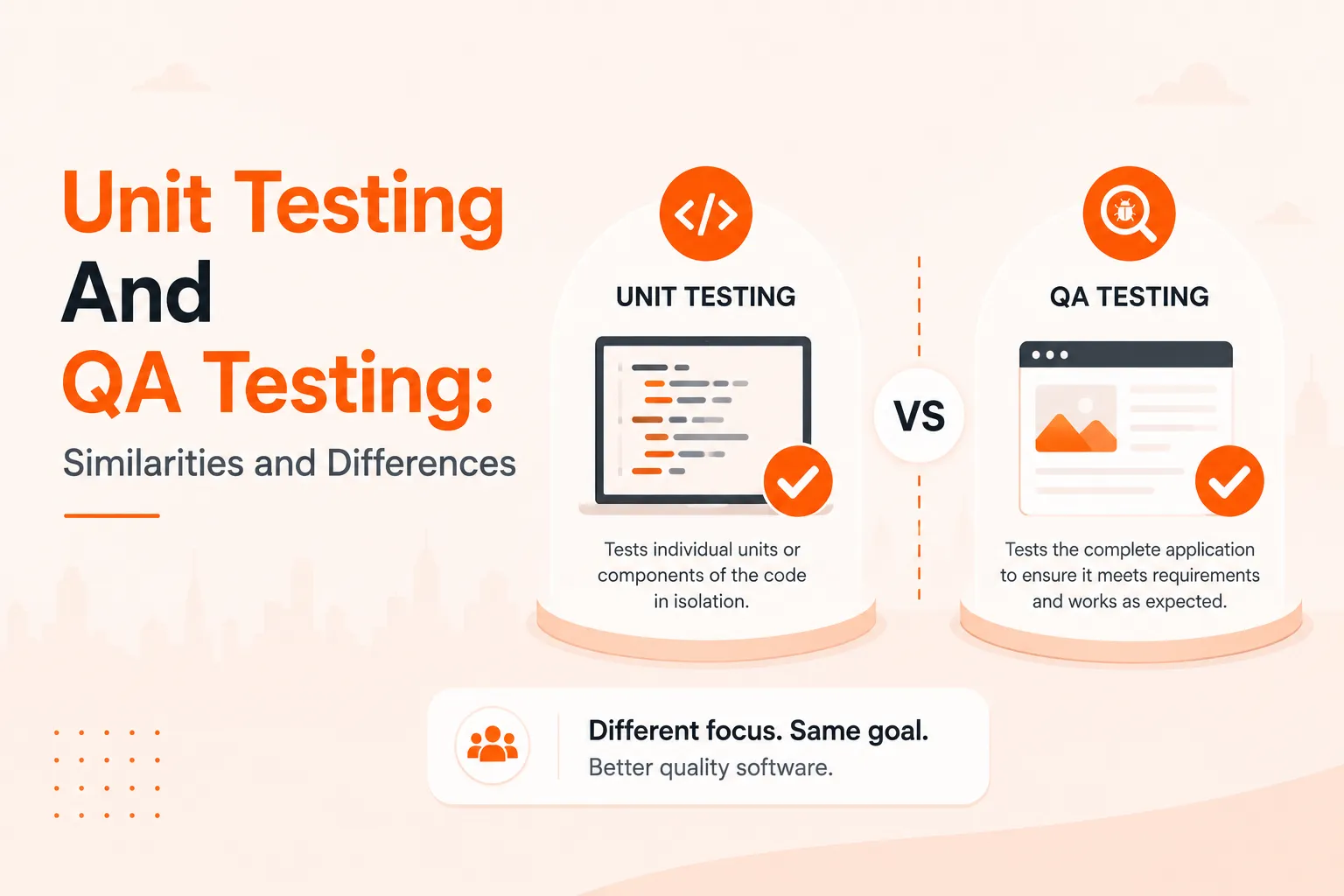
The software development lifecycle depends on a critical stage where applications must perform according to expected functionality, reliability, and user requirements. Before software reaches end-users, testing is essential for identifying defects, reducing risks, and ensuring stable performance.
Businesses rely on two important testing methods: unit testing and quality assurance (QA) testing. While both are designed to improve software quality, they serve different purposes and operate at different stages of development. This article explains how both testing approaches work and how they complement each other to support reliable software delivery.
What is Unit Testing in QA?
Unit testing is a software testing approach that verifies individual components or units of code in isolation. A “unit” typically refers to a function, method, or module that performs a specific task within an application.
Developers perform unit testing during the coding phase to confirm that each component behaves as expected under different conditions. Popular frameworks such as JUnit (Java), PyTest (Python), and NUnit (.NET) support automated execution of tests, helping teams detect issues early, maintain code stability, and reduce regression risks during updates.
Because unit tests focus on isolated logic, they help developers validate core functionality before components are integrated into larger systems.
What is QA Testing?
QA testing is a broader process that evaluates the overall quality of a software application by ensuring it meets functional, performance, security, and user requirements.
Unlike unit testing, QA testing evaluates how different components work together within the complete system. It includes testing approaches such as functional testing, integration testing, system testing, regression testing, and user acceptance testing. Industry-recognized organizations such as ISTQB also provide widely accepted testing standards and best practices followed by QA professionals worldwide.
An experienced QA tester or QA engineer focuses on application behavior, usability, security, reliability, and performance to ensure the final product aligns with stakeholder expectations and delivers a consistent user experience.
Similarities Between Unit Testing and QA Testing
Although unit testing and QA testing differ in scope and execution, they share several important objectives.
Improving Quality
Both methods aim to deliver reliable, stable, and high-performing software that meets user and business expectations.
Error Detection
Unit testing identifies defects within individual components, while QA testing detects issues that affect the system as a whole.
Automation Possibilities
Both testing approaches can be automated. Unit testing frameworks and automated QA tools such as Selenium, Playwright, and Cypress improve testing efficiency, coverage, and consistency across modern software applications.
Continuous Process
Both should be integrated throughout the software development lifecycle to support continuous quality improvement and reduce post-release issues.
Unit Testing vs QA Testing: Key Differences
Unit testing vs QA testing: while both contribute to software quality, they differ in testing scope, execution methods, and objectives.
|
Aspect
|
Unit Testing
|
QA Testing
|
|
Scope
|
Focuses on individual components such as functions or methods
|
Covers the complete software system and component interactions
|
|
When Performed
|
During development, immediately after writing code
|
After unit testing, when the application reaches a more stable state
|
|
Who Performs
|
Developers
|
QA engineers or testers
|
|
Focus
|
Verifies functionality of isolated units
|
Evaluates usability, performance, security, reliability, and integration
|
|
Automation
|
Highly automated using testing frameworks
|
Can be automated or manual depending on testing requirements
|
The Relationship Between Unit Testing and QA Testing
Delivering high-quality software requires both unit testing and QA testing to work together as part of a structured development process.
Unit testing helps identify issues at the component level early in development, reducing the likelihood of defects spreading into later stages. QA testing then validates that the entire application functions correctly from a user and business perspective.
An effective software development lifecycle typically begins with unit testing to validate core functionality. Once components are stable, QA testing evaluates how they interact within the full system, ensuring performance, usability, security, and reliability before release.
Customer Success Story: How Multisyn Helps Clients Achieve Quality
Multisyn has helped multiple clients strengthen software quality by combining structured unit testing with comprehensive QA strategies across web, mobile, and enterprise applications.
By implementing consistent testing practices throughout development, clients have experienced improved software reliability, smoother user experiences, and reduced post-release issues.
Our approach includes:
-
Rigorous unit testing to validate individual components and business logic
-
End-to-end QA evaluation covering performance, security, usability, and integration
-
Continuous testing integration to support long-term application stability
This combined testing strategy enables businesses to launch products with greater confidence while maintaining software quality as systems scale.
Frequently Asked Questions (FAQs)
Is unit testing part of QA testing?
Yes, unit testing is considered part of the overall quality assurance (QA) process. It focuses on validating individual components of code to ensure they function correctly. QA testing extends beyond this by evaluating the complete system, including performance, usability, security, and integration, to ensure the final product meets both technical and business requirements.
Do developers or QA testers perform unit testing?
Developers primarily perform unit testing during the coding phase. They write and execute tests to verify that each function, method, or module behaves as expected. This early-stage testing helps identify issues before the code progresses to broader QA testing stages.
Can unit testing replace QA testing?
No, unit testing cannot replace QA testing. Unit testing validates individual components in isolation, while QA testing evaluates the application as a complete system. QA testing also covers areas such as usability, integration, security, and performance, which are outside the scope of unit testing alone.
What’s the difference between unit testing and integration testing?
Unit testing focuses on verifying individual components independently, such as functions or methods. Integration testing evaluates how multiple components interact with each other, ensuring modules communicate correctly and data flows properly throughout the system.
How much of QA testing can be automated?
A significant portion of QA testing can be automated, particularly regression testing, functional testing, and performance testing. However, areas such as usability testing and exploratory testing still require manual evaluation because they depend on human judgment and real-user interaction. Security-focused QA processes also commonly follow guidance from organizations like OWASP to identify vulnerabilities and strengthen application security.
Which comes first, unit testing or QA testing?
Unit testing comes first during the software development process. It is performed while code is being developed to validate individual components. QA testing follows after components are integrated into a more stable application environment, ensuring the complete system functions correctly and meets user expectations.
Why Both Testing Approaches Matter
Unit testing and QA testing are both essential for delivering high-quality software. While unit testing focuses on individual components, QA testing ensures the entire application works seamlessly across different scenarios and user conditions.
By combining both approaches, development teams can reduce errors, improve software stability, and deliver better user experiences.
At Multisyn, our testing services are designed to meet your specific business and technical requirements. Whether you need unit testing, QA testing, or a complete quality assurance strategy, our team can help strengthen your software development process and product reliability.