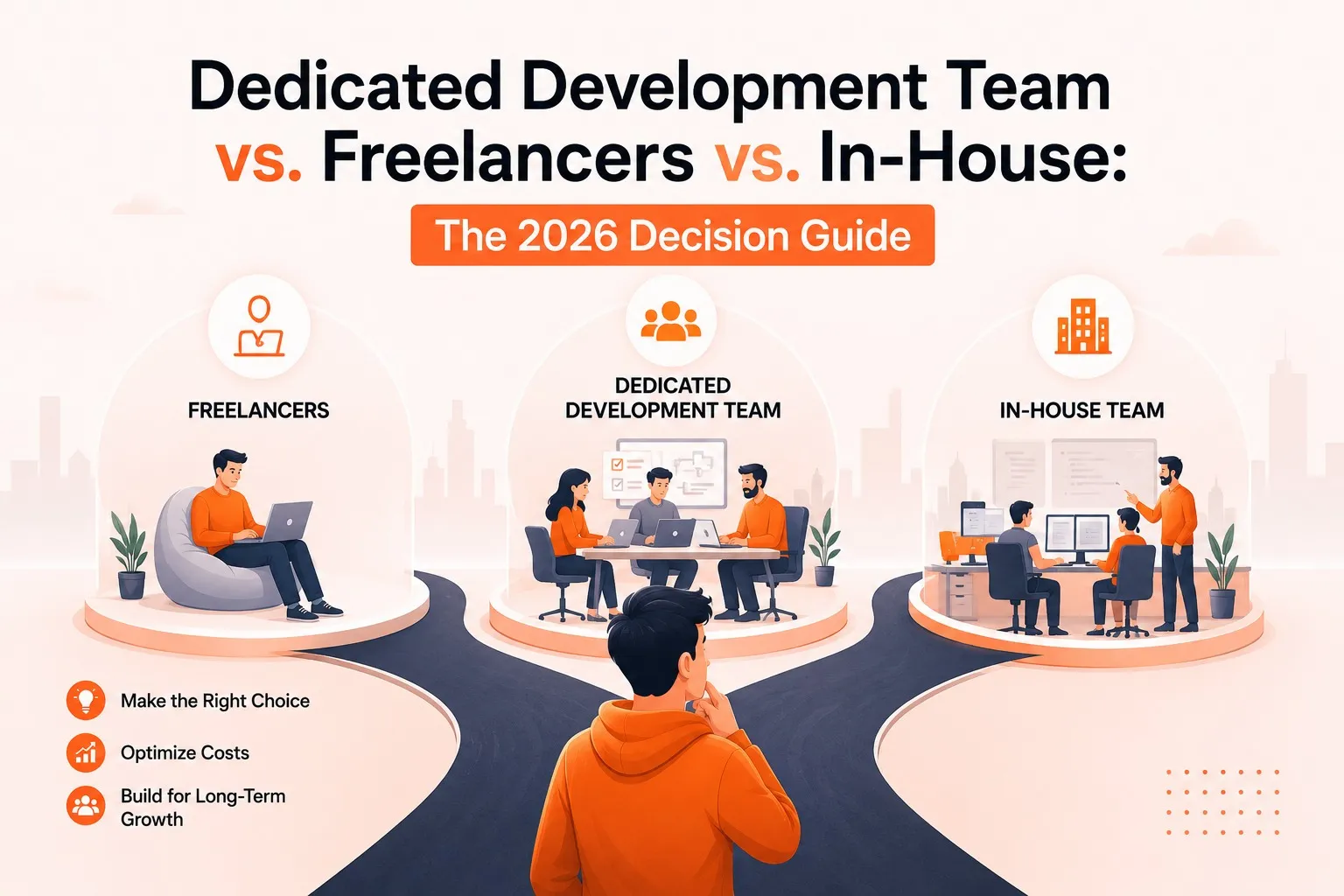
A dedicated development team is usually the best choice for startups building products with a roadmap longer than six months. Freelancers work best for short-term projects under 3 months, while in-house software development is the better option once engineering becomes a long-term business function.
Answer These 3 Questions to Get a Recommendation
Question 1: Will development continue for more than 6 months?
Question 2: Do you have technical leadership in-house?
Question 3: Is engineering a permanent business function?

Choosing among a dedicated development team, freelancers, and in-house software development affects your budget, delivery speed, and ability to scale. In this guide, we'll compare all three models, show real-world cost scenarios, and help you determine whether a dedicated software development team, freelancers, or in-house hiring fits your current stage of growth.
The right hiring model affects far more than cost. It influences delivery speed, product quality, management overhead, and your ability to scale over time.
When freelancers are the right call
Freelancers are a practical choice when your project is well-defined, time-sensitive, and doesn't require extensive collaboration. They offer flexibility, lower upfront costs, and access to specialized expertise without the commitment of building a full team.
Best for Short-Term Projects
Freelancers are often the fastest and most cost-effective option for short-term projects. If you need a landing page, a specific feature, or a one-time integration, hiring a freelancer can be more efficient than building an in-house team or engaging a dedicated development team.
They perform best when the scope is fixed, the timeline is under three months, and deliverables are clearly defined from the start.
Access Specialized Skills on Demand
Freelancers are a strong fit when you need niche expertise for a limited period. Whether it's blockchain development, machine learning, or a complex third-party integration, you can bring in the right specialist without making a long-term hiring commitment.
Works Best with Simple Coordination
Freelancers thrive when they can work independently. As projects become larger or involve multiple contributors, someone must manage communication, dependencies, code quality, and timelines.
Without a technical lead, coordinating several freelancers can quickly become a challenge.
Signs Freelancers Are the Right Choice
Freelancers are usually the right option when:
-
The project will take less than three months
-
Requirements are clearly defined upfront
-
You need a specific skill or a specialist
-
A technical person can review the work
-
Long-term ownership and continuity are not priorities
If your project requires ongoing development and collaboration, a dedicated software development team is often the more reliable choice.
When a Dedicated Development Team Wins
A dedicated development team is an external team that works exclusively on your product. Unlike freelancers, you get a structured setup that often includes developers, QA engineers, project managers, and ongoing support. This model works best when you're building a product that requires continuous development and long-term collaboration.
Products With a 6+ Month Roadmap
An experienced team becomes the stronger choice when your roadmap extends beyond six months.
Over time, the team develops a deep understanding of your product, codebase, and business goals. That familiarity reduces onboarding time, speeds up development, and helps avoid costly rework. Instead of constantly bringing new people up to speed, you keep moving forward.
Predictable Monthly Costs
With a software development team, costs are easier to plan for.
Rather than managing multiple freelancers with different rates and availability, you work with a stable team and a consistent monthly budget. For founders managing runway and growth plans, that predictability can be just as valuable as the cost itself.
Knowledge Continuity Across the Build
One of the biggest advantages of a team model is continuity.
Because the same people stay involved throughout development, product knowledge accumulates over time instead of being lost with every new hire or contractor. Most dedicated development team services also include project management, sprint planning, and progress tracking. With dedicated software development team services, founders spend less time on day-to-day coordination and more time on product decisions.
Signs a Dedicated team is the right fit
A dedicated team for software development is usually the right fit when:
-
Your product roadmap extends beyond six months
-
You want predictable development costs
-
Knowledge continuity is important
-
You need multiple roles working together
-
You do not have time to manage freelancers directly
If you're building a long-term product rather than completing a short-term project, this model often provides the best balance of speed, stability, and cost control.
When In-House Hiring Makes Sense
Building an in-house software development team is often the end goal for growing companies, but it is rarely the best place to start. Compared to freelancers or dedicated teams, hiring full-time engineers comes with higher costs, including salaries, benefits, recruiting expenses, and management overhead.
When Engineering Becomes a Core Business Function
The investment in an in-house team makes sense when software development becomes a permanent part of the business.
At this stage, your product is established, your roadmap is clear, and you need a team that is fully aligned with company goals. Many startups reach this point after validating their product and proving market demand. It's common to start with freelancers or a dedicated development team and gradually bring development in-house as the company grows.
Long-Term IP and Compliance Control
An in-house team can be the best option when intellectual property, security, or regulatory compliance requires tighter control.
If your codebase is a key competitive advantage or your industry has strict compliance requirements, keeping development internal gives you greater oversight and reduces reliance on external partners.
You have the Budget for recruiting and benefits
Hiring full-time engineers involves more than salaries. Recruiting costs, employee benefits, onboarding, equipment, and training can significantly increase the total cost of building an in-house software development team.
For companies with long-term development needs, these investments can be worthwhile. However, it's important to budget for the full cost of hiring and retaining talent, not just compensation.
Signs of in-house hiring make sense
In-house hiring is usually the right fit when:
-
You have achieved product-market fit
-
Your product will require ongoing development for years
-
IP protection or compliance is a priority
-
You have a technical leader who can manage hiring and delivery
-
You have the budget for recruiting, salaries, and benefits
For many startups, the real decision is not in-house vs outsourcing software development. It's choosing the right model for your current stage and evolving your approach as the business grows.
Real Cost Comparison: Three Common Scenarios
Choosing between freelancers, a dedicated development team, and in-house software development often comes down to cost. While actual budgets vary by region and skill level, the examples below show how each model typically compares.
Note: Cost estimates assume offshore dedicated teams, mid-market freelancer rates, and US/UK in-house employment costs. Actual figures vary by region, seniority, and project scope.
Scenario 1: 3-Month MVP Build
Factor
|
Freelancers
|
Dedicated Team
|
In-House
|
|
Team composition
|
2 developers
|
2 developers + PM
|
2 developers
|
|
Monthly cost
|
$8,000–$15,000
|
$9,000–$18,000
|
Not viable
|
|
Total cost
|
$24,000–$45,000
|
$27,000–$54,000
|
N/A
|
|
Management overhead
|
High
|
Low
|
N/A
|
|
Risk
|
Availability, coordination
|
Low if scoped well
|
Not practical
|
Verdict: For a short-term MVP, freelancers and a dedicated team are both viable. A dedicated team often provides better coordination and delivery predictability.
If you're planning an MVP, our MVP development agency guide breaks down how to scope and budget an early-stage product.
Scenario 2: 12-Month Product Build
|
Factor
|
Freelancers
|
Dedicated Team
|
In-House
|
|
Team composition
|
3 developers
|
3 developers + PM + QA
|
2–3 developers
|
|
Monthly cost
|
$15,000–$30,000
|
$15,000–$25,000
|
$30,000–$50,000
|
|
Total cost
|
$180,000–$360,000
|
$180,000–$300,000
|
$360,000–$600,000+
|
|
Knowledge continuity
|
Low
|
High
|
High
|
|
Scalability
|
Medium
|
High
|
Low
|
Verdict: For a year-long roadmap, a dedicated software development team typically offers the best balance of cost, continuity, and scalability.
Scenario 3: 24-Month Scale-Up
|
Factor
|
Freelancers
|
Dedicated Team
|
In-House
|
|
Team composition
|
Project-based contributors
|
4–6 developers + PM + QA
|
3–4 core developers
|
|
Monthly cost
|
$25,000–$50,000+
|
$20,000–$35,000+
(Custom based on scope)
|
$50,000–$90,000+
|
|
Total cost
|
Variable
|
$480,000–$840,000
(Custom based on scope)
|
$1.2M–$2.2M+
|
|
Flexibility
|
Medium
|
High
|
Low
|
|
IP & culture alignment
|
Weak
|
Medium
|
Strong
|
Verdict: As products mature, many companies adopt a hybrid model: an in-house leadership team supported by a dedicated team for software development. This approach balances cost, flexibility, and long-term ownership.
Note: These figures are illustrative benchmarks, not quotes. Dedicated team rates reflect offshore providers in South/Southeast Asia and Eastern Europe. Freelancer rates reflect mid-market Western talent. In-house costs include salary, benefits, taxes, and recruiting overhead based on US/UK market data.
The numbers highlight one important reality: there is no universal winner in the dedicated development team vs. freelancers vs. in-house debate. The right choice depends on your stage, budget, and growth plans.
Hybrid Models
Many startups eventually discover that the best solution is not freelancers, a dedicated development team, or in-house hiring alone. It is a combination of all three.
A common setup is one in-house technical leader—such as a CTO or Head of Engineering—working alongside a dedicated software development team. The internal leader owns the product vision, architecture, and technical decisions, while the dedicated team handles day-to-day development, testing, and delivery.
This model works because it combines strategic control with execution capacity. You retain ownership of key technical decisions without taking on the cost and complexity of building a full in-house engineering department.
The hybrid approach is often the next step after an MVP. Founders can move quickly with a dedicated team, then selectively hire in-house as the product matures and long-term roles become clearer.
A hybrid model works best when:
-
You have a technical leader in-house
-
You want to scale development without expanding payroll too quickly
-
Your product requires ongoing development and regular releases
-
You need flexibility while building a long-term team
To make this model successful, treat the dedicated team as part of the product organization. Include them in planning, communication, and roadmap discussions. The strongest partnerships operate as one team, not a client-vendor relationship.
For many growing startups, pairing a team for software development with one in-house technical leader becomes the most practical answer to the dedicated development team vs. freelancers vs. in-house decision.
Final Thoughts
There is no universal winner in the Dedicated Development Team vs. Freelancers vs. In-House debate. The right choice depends on your product stage, budget, and growth plans.
-
Choose freelancers for short-term projects and specialized tasks.
-
Choose a dedicated development team when you need consistent delivery, predictable costs, and long-term product development.
-
Choose in-house software development when the product is mature, and engineering becomes a core business function.
-
Choose a hybrid model when you want the flexibility of a dedicated team while gradually building an in-house engineering function.
Many successful startups use all three models at different stages. What matters is choosing the model that fits your current needs, not the one you expect to need years from now.
Frequently Asked Questions
Can I switch from freelancers to a dedicated development team mid-project?
Yes. Many startups start with freelancers and move to a dedicated development team as the product grows. The key is a smooth handover with access to the codebase, documentation, and technical decisions. Most dedicated teams spend a short onboarding period reviewing the existing work before taking over.
Who owns the code when working with a dedicated team?
You should own the code, intellectual property, and project assets. Before signing, confirm that ownership terms are clearly stated in the contract and that you have full access to repositories, documentation, and deployment environments.
How long does it take a dedicated software development team to get up to speed?
For a new project, a dedicated software development team can usually begin delivering within one to two weeks. If they are taking over an existing product, onboarding may take two to four weeks, depending on the complexity of the codebase.
What happens if I want to end the engagement?
Most dedicated development team services include a notice period and a structured handover process. Before signing, review the exit terms to ensure you retain access to the code, documentation, and other project assets.
Can a dedicated team scale up or down as our needs change?
Yes. One of the biggest advantages of hiring a dedicated development team is flexibility. You can usually add or reduce team members as priorities change, allowing development costs to align with your current stage of growth.
Is outsourcing software development better than hiring in-house?
It depends on your stage. For most early-stage startups, outsourcing software development through a dedicated team costs significantly less than building in-house and gets products to market faster. In-house hiring makes more sense once you have product-market fit, a clear long-term roadmap, and the budget for salaries, benefits, and recruiting overhead.
Still deciding between freelancers, a dedicated development team, or in-house hiring? Reviewing your roadmap, budget, and growth plans often makes the right choice much clearer.
At Multisyn, we've helped startups build products through dedicated teams, MVP engagements, and long-term engineering partnerships. The right model depends on your stage, budget, and roadmap.
Talk to Us About a Dedicated Team→