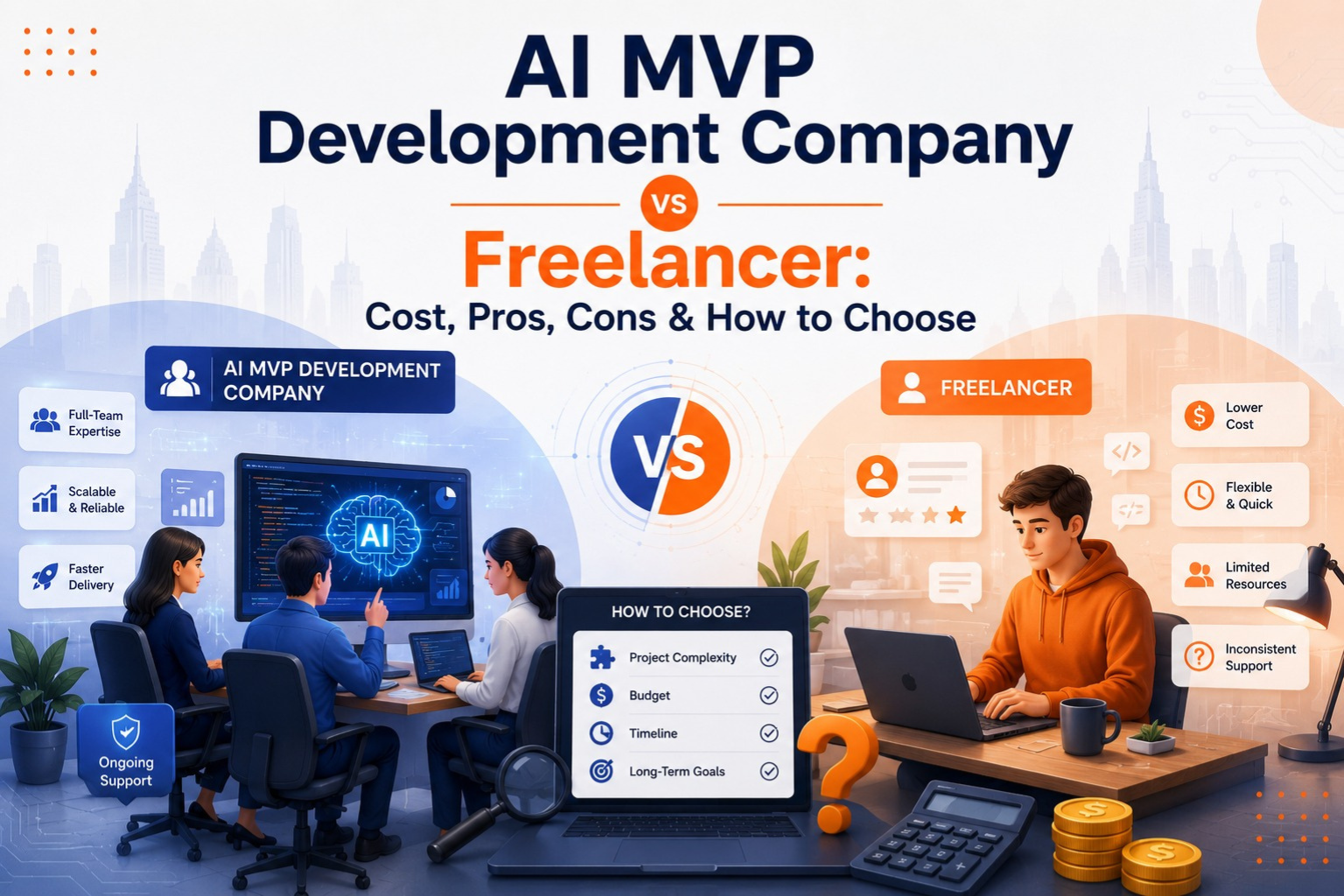
Choosing between an AI MVP development company and a freelance AI developer is not simply a question of which option costs less. The better choice depends on the complexity of your product, the AI functionality involved, your existing team, budget, timeline, and the amount of support you need after launch.
A freelancer can be a practical choice for a focused MVP with a clearly defined scope and straightforward AI integration. A development company can make more sense when the product requires multiple specialists across AI, UI/UX, frontend, backend, QA, infrastructure, and product strategy.
The key is to match the development model to the actual needs of your MVP rather than choosing based only on price.
A Quick Decision: Company or Freelancer?
Choose an AI MVP development company if you need multiple specialists, complex AI functionality, product strategy, UI/UX design, several integrations, dedicated QA, or ongoing technical support.
Choose a freelance AI developer if your MVP has a focused scope, uses straightforward AI functionality, or you already have design, product, or technical resources.
A useful rule is simple:
The more disciplines your MVP requires, the more useful a coordinated development team can become. The more focused the technical requirement, the more practical a specialist freelancer may be.
AI MVP Development Company vs Freelancer: What's the Difference?
Both an AI MVP development company and a freelancer can build a functional MVP, but they usually work in different ways.
A development company typically provides access to several roles under one engagement. Depending on the project, this may include AI engineers, frontend and backend developers, UI/UX designers, QA specialists, DevOps engineers, and project managers.
A freelancer generally works as an individual specialist. They may be highly experienced in AI development, backend engineering, frontend development, or another technical area, but they may not cover every discipline required by a larger product.
The important question is therefore not:
"Which one is better?"
It is:
"How much of the product development process do I need one person to handle?"
What an AI MVP Development Company Provides
An AI MVP development company may provide several capabilities within one team, including:
-
Product discovery and MVP planning
-
Feature prioritization
-
UI/UX design
-
AI and machine learning development
-
LLM and AI API integration
-
Frontend development
-
Backend development
-
Database architecture
-
Third-party integrations
-
Cloud infrastructure
-
Quality assurance and testing
-
Deployment
-
Monitoring
-
Maintenance and post-launch support
This structure can be useful when several parts of the MVP need to be developed and tested together.
For example, an AI SaaS product may require user authentication, a dashboard, subscription billing, an AI workflow, a database, third-party integrations, analytics, and testing. Coordinating all of these areas through one team can reduce the management burden on the founder.
What a Freelance AI Developer Typically Provides
A freelance AI developer can be a strong option when the technical requirement is focused.
Depending on their experience, a freelancer may handle:
For example, if you already have your UI design and backend architecture and only need someone to integrate an AI feature using an API such as OpenAI's API, hiring a specialist may be more efficient than bringing in a complete development team.
The limitation appears when the project expands beyond the freelancer's expertise.
You may then need separate resources for:
-
UI/UX
-
Backend architecture
-
QA
-
DevOps
-
Security
-
Product strategy
-
Advanced AI engineering
At that point, the lower initial cost of a freelancer may no longer represent the lowest overall cost.
AI MVP Development Cost: Company vs Freelancer
Cost is one of the most common reasons startups consider freelancers. Individual developers often have lower initial rates because the startup is hiring one person rather than a multidisciplinary team.
However, the development partner is only one part of the total AI MVP cost.
The final budget can also be affected by:
Why a Development Company May Cost More
A company can have a higher initial price because the engagement may involve several specialists.
For example, one project might require:
-
A product manager
-
UI/UX designer
-
AI engineer
-
Backend developer
-
Frontend developer
-
QA engineer
-
DevOps support
You are not necessarily paying only for coding hours. You may also be paying for coordination, testing, architecture, project management, and access to additional expertise.
Why a Freelancer May Cost Less Initially
A freelancer can be more cost-effective when you only need one specific capability.
This can work particularly well when you have:
-
A limited MVP scope
-
Existing product specifications
-
Completed UI/UX designs
-
An existing technical team
-
A technical co-founder
-
A straightforward AI integration
-
A limited initial budget
However, additional costs can appear when the MVP requires skills outside the freelancer's expertise.
Total Cost of Ownership: Company vs Freelancer
The initial development quote should not be the only number you compare.
Consider what happens if the MVP needs a designer, QA specialist, DevOps engineer, or additional AI developer halfway through development.
|
Cost Consideration
|
AI MVP Development Company
|
Freelancer
|
|
Initial development cost
|
Usually higher
|
Usually lower
|
|
Multiple specialists
|
Usually available
|
May require additional resources
|
|
Project management
|
Often included
|
Usually handled directly by startup
|
|
UI/UX
|
May be included
|
May require separate designer
|
|
QA and testing
|
Dedicated resources may be available
|
May be handled by developer or another resource
|
|
DevOps
|
May be handled within team
|
May require additional expertise
|
|
Maintenance
|
Often available through same team
|
Depends on agreement and availability
|
|
Team scaling
|
Easier to add specialists
|
Depends on freelancer's capacity
|
|
Management effort
|
Generally lower
|
Can increase as more resources are added
|
|
Cost predictability
|
Often easier for defined scope
|
Can change when additional skills are required
|
The goal is not to assume that a company is always cheaper in the long run or that a freelancer is always cheaper.
Instead, compare the complete cost of getting the MVP built, launched, tested, and maintained.
Additional AI MVP Costs to Consider
Development is only one part of operating an AI MVP.
AI products can have additional costs that traditional software products may not have.
AI Model or API Usage
AI API costs can depend on factors such as the number of requests, tokens processed, model selected, and usage patterns.
A product with a small user base may have modest AI costs initially but require a different budget as usage grows.
AI Development Tools
Some development, testing, monitoring, and AI evaluation tools may require paid subscriptions.
Cloud Infrastructure
Your MVP may require:
The requirements depend on how the product is built.
Third-Party Services
You may also need separate services for:
-
Authentication
-
Payments
-
Analytics
-
Email
-
Communication
-
File storage
-
Search
-
AI APIs
AI Monitoring and Evaluation
AI output needs to be evaluated differently from conventional application functionality.
Depending on the product, you may need to monitor:
-
Accuracy
-
Relevance
-
Consistency
-
Response quality
-
Failure cases
-
User feedback
-
Model performance
Maintenance and Model Updates
AI models, APIs, libraries, and third-party services can change over time.
An MVP may therefore require ongoing updates even when the core product remains unchanged.
What Makes AI MVP Development Different?
An important consideration is that AI MVP development has risks beyond normal software development.
An AI feature may work correctly from a technical perspective while still producing poor results for users.
For example, an AI application may need to handle:
-
Hallucinations
-
Inconsistent responses
-
Incorrect classifications
-
Poor-quality generated content
-
Prompt changes
-
Model changes
-
API changes
-
Increasing usage costs
-
Data privacy requirements
-
Model evaluation
This means you should evaluate a developer or company not only on whether they can connect an AI API, but also on whether they understand how to test, monitor, and improve AI behavior.
AI Evaluation Should Be Part of the MVP
Before hiring a developer, ask:
-
How will AI output quality be measured?
-
What happens when the model produces an incorrect result?
-
Will test cases be created for important workflows?
-
How will model or prompt changes be evaluated?
-
How will failures be logged?
-
What fallback behavior will be used?
These questions can reveal whether the developer understands AI product development or is simply adding an API call to a conventional application.
AI MVP Complexity: What Level of Development Do You Need?
Not every AI MVP requires a large development team.
Focused AI MVP
A focused MVP might use an existing AI model and contain one or two primary workflows.
For example:
If the scope is clearly defined and the startup already has design or technical resources, a freelancer may be sufficient.
Medium-Complexity AI MVP
A medium-complexity product might combine AI with:
-
User authentication
-
Dashboard
-
Database
-
Payments
-
Analytics
-
Multiple APIs
-
Admin functionality
-
Several user workflows
At this stage, coordination becomes more important.
A small multidisciplinary team may be more practical if several parts of the product need to be developed simultaneously.
Complex AI MVP
A complex AI MVP may involve:
Projects at this level may benefit from access to several specialists rather than relying on one developer.
Company vs Freelancer: Real-World Startup Scenarios
Looking at realistic situations can make the decision easier.
Scenario 1: Founder Needs One AI Feature
A startup already has:
-
UI/UX designs
-
Backend infrastructure
-
Product requirements
-
Authentication
The only missing component is an AI-powered recommendation feature.
Likely choice: Freelancer
A specialist developer may be enough because the startup already has the rest of the technical resources.
Scenario 2: Founder Has an AI SaaS Idea but No Technical Team
The product requires:
-
Product planning
-
UI/UX
-
Frontend
-
Backend
-
AI integration
-
Payments
-
Database
-
Testing
-
Deployment
Likely choice: Development company
The founder is not simply looking for a developer. They need a coordinated product development team.
Scenario 3: Startup Wants to Validate a Simple AI Workflow
The goal is to test whether users will pay for one AI-powered workflow before investing in a larger platform.
Likely choice: Freelancer
A focused specialist may help the startup validate the core idea without building unnecessary infrastructure.
Scenario 4: AI Product Handles Complex Data
The MVP processes large volumes of documents and requires:
-
Data extraction
-
AI processing
-
Evaluation
-
Security
-
Cloud infrastructure
-
Multiple integrations
Likely choice: Company or multidisciplinary team
The key concern is no longer simply building the AI feature. Architecture, data processing, security, testing, and infrastructure all become important.
Startup Situation vs Recommended Option
|
Startup Situation
|
Likely Fit
|
Why
|
|
Simple AI feature
|
Freelancer
|
One experienced developer may be enough
|
|
AI proof of concept
|
Freelancer
|
Focused technical work can validate the idea
|
|
Clearly defined MVP
|
Freelancer
|
Direct communication can work well for limited scope
|
|
Existing technical team
|
Freelancer
|
Can fill a specific skill gap
|
|
Existing UI/UX design
|
Freelancer
|
Less need for a complete product team
|
|
Complex AI SaaS
|
Development company
|
Multiple disciplines may be required
|
|
Several third-party integrations
|
Development company
|
Coordination becomes more important
|
|
Custom AI/ML development
|
Company or specialist team
|
May require specialized expertise
|
|
No technical co-founder
|
Development company
|
Broader product and technical support may be useful
|
|
UI/UX + development + QA required
|
Development company
|
Several roles need to work together
|
|
Long-term product development
|
Development company or team
|
Easier access to additional resources
|
|
Very limited budget
|
Freelancer
|
Lower initial cost may be more practical
|
These are guidelines rather than fixed rules. A highly experienced freelancer may successfully handle a project that another company would consider complex, while a development company may be unnecessary for a very simple product.
Company vs Freelancer: Key Differences
Team Expertise
A freelancer's biggest strength can be depth in a particular technical area.
A development company's advantage is broader access to different disciplines.
For an AI MVP, relevant capabilities can include:
-
LLMs
-
Generative AI
-
Machine learning
-
AI APIs
-
Prompt engineering
-
Data processing
-
Backend engineering
-
Cloud infrastructure
-
Security
-
AI evaluation
-
Quality assurance
When several of these capabilities are needed at the same time, team structure becomes more important.
Product Strategy
An MVP should not simply contain as many features as possible.
The development process should identify what needs to be built to test the product hypothesis.
A development partner may help with:
-
Feature prioritization
-
User flows
-
Technical feasibility
-
MVP scope
-
Technology selection
-
Development roadmap
-
Iteration planning
If you already have this work completed, a freelancer may be sufficient for implementation.
Project Management
With a freelancer, communication is usually direct.
That can be an advantage for smaller projects because you communicate directly with the person building the product.
A company may introduce a project manager or another point of contact who coordinates multiple specialists.
That additional structure can become useful when several teams or technical disciplines are involved.
Scalability
Think about what happens after the first release.
You may need:
A company may be able to add specialists as requirements change.
A freelancer may also provide ongoing support, but this depends on their availability and agreement.
Security, Data and Intellectual Property
AI MVPs can process sensitive business or customer information, so security and ownership should be discussed before development begins.
Ask About Data Security
Depending on the product, ask:
-
Where will data be stored?
-
Who can access production data?
-
How are API keys managed?
-
How is sensitive information protected?
-
What security practices are followed?
-
How are development and production environments separated?
Clarify Intellectual Property
Your agreement should clearly explain ownership of:
-
Source code
-
UI designs
-
Database structure
-
Prompts
-
Documentation
-
Product data
-
Custom models
-
Evaluation datasets
-
Other project assets
Avoid Unnecessary Vendor Lock-In
For an AI MVP, also ask whether the product is tightly dependent on one AI provider.
Questions worth asking include:
-
Can the application support another model later?
-
Who owns the AI provider account?
-
Who controls the API keys?
-
Can the startup change providers?
-
Is the architecture designed around one specific model?
You may not need a multi-model architecture for an MVP, but understanding the trade-off can help prevent expensive changes later.
How to Choose the Right AI MVP Development Partner
Once you know whether you need a freelancer or a development company, evaluate the actual candidates carefully.
1. Look for Relevant AI Experience
Don't rely only on a general software portfolio.
Look for experience with AI functionality similar to what your product needs.
2. Check MVP Experience
A strong development partner should understand:
-
Feature prioritization
-
MVP scope
-
Validation
-
Rapid iteration
-
Technical trade-offs
Building a large application and building an MVP require different decisions.
3. Evaluate AI Technical Capabilities
Ask about experience with:
-
LLMs
-
AI APIs
-
Machine learning
-
Data processing
-
AI evaluation
-
Model selection
-
AI frameworks
The important question is not simply "Can you integrate AI?"
Ask:
"Why would you choose this AI approach for my product?"
4. Review Similar Projects
Ask for relevant case studies or portfolio examples.
Look for evidence of actual product work rather than generic technology claims.
For example, MultisynTech's portfolio can be reviewed alongside other candidates when evaluating previous project experience.
5. Understand the Development Process
Ask how they handle:
-
Discovery
-
Scope definition
-
Design
-
Development
-
AI integration
-
Testing
-
Deployment
-
Post-launch support
You should also understand how progress will be reported.
6. Ask How AI Is Tested
This is especially important.
Ask how the developer will evaluate:
-
Accuracy
-
Relevance
-
Consistency
-
Edge cases
-
Failure scenarios
-
User feedback
7. Understand the Team
If you're hiring a company, ask who will actually work on the project.
Find out whether the team includes the roles your MVP requires.
8. Check Availability
A developer can be technically excellent but still be a poor fit if they cannot dedicate enough time to the project.
Ask:
-
When can development begin?
-
How many hours or resources will be allocated?
-
Who handles urgent issues?
-
What happens if the primary developer becomes unavailable?
9. Clarify Communication
Agree on:
-
Communication channels
-
Meeting frequency
-
Progress updates
-
Primary contact
-
Response expectations
10. Clarify Ownership and Support
Before signing, understand:
-
Source-code ownership
-
Intellectual property
-
Hosting ownership
-
API accounts
-
Documentation
-
Maintenance
-
Bug fixes
-
Future development
11. Understand Change Requests
MVP requirements often change after development begins.
Ask how changes will be:
-
Documented
-
Estimated
-
Approved
-
Prioritized
-
Charged
12. Compare Scope, Not Just Price
When comparing proposals, look at the complete package.
A $10,000 proposal and a $15,000 proposal may not be directly comparable if one includes UI/UX, QA, deployment, documentation, and support while the other only includes development.
Questions to Ask Before Hiring an AI MVP Developer
Before choosing a freelancer or development company, ask:
-
Have you built an AI MVP similar to mine?
-
Which AI models or APIs would you recommend and why?
-
What should be included in the first MVP?
-
What is included in the development scope?
-
Who handles UI/UX, backend, AI integration, and QA?
-
How will AI-generated outputs be tested?
-
How will user and business data be protected?
-
Who owns the source code and intellectual property?
-
Who owns the AI provider accounts and API keys?
-
What happens if the MVP scope changes?
-
What support is available after launch?
-
How are AI usage and infrastructure costs estimated?
The answers can tell you much more about a potential partner than a low hourly rate or polished sales presentation.
AI MVP Development Company: Pros and Cons
Pros
-
Access to multiple specialists
-
Broader technical capabilities
-
Structured project management
-
Product strategy may be available
-
Easier access to additional resources
-
Potential long-term support
Cons
Freelance AI Developer: Pros and Cons
Pros
-
Lower initial cost
-
Direct communication
-
Flexible engagement
-
Good fit for focused projects
-
Useful for filling specific technical gaps
-
Can be efficient for prototypes and proofs of concept
Cons
-
Limited individual capacity
-
May not cover every discipline
-
Availability can become a concern
-
Complex projects may require additional specialists
-
More responsibility may fall on the founder
Final Verdict: Company or Freelancer for AI MVP Development?
There is no universally better option.
A freelance AI developer can be the better choice when you have a focused MVP, clearly defined requirements, straightforward AI functionality, existing product resources, or a limited initial budget.
An AI MVP development company can be the better choice when you need multiple specialists, complex AI functionality, product strategy, UI/UX, several integrations, dedicated QA, infrastructure support, or continued development after launch.
The most important factor is fit.
Before choosing a development partner, compare:
-
AI expertise
-
MVP experience
-
Relevant projects
-
Technical architecture
-
AI evaluation approach
-
Team capabilities
-
Development process
-
Security
-
Intellectual property
-
Communication
-
Post-launch support
-
Total cost
The cheapest option is not automatically the most cost-effective, and the largest development team is not automatically the best choice.
Choose the development model that matches the complexity, risk, and goals of your MVP.
Frequently Asked Questions
Is an AI MVP development company better than a freelancer?
An AI MVP development company may be a better fit when the product requires multiple specialists, complex AI functionality, product strategy, UI/UX, integrations, QA, or ongoing support. A freelancer may be better for a focused MVP with clearly defined requirements.
Are freelancers cheaper for AI MVP development?
Freelancers are often less expensive initially because you are hiring an individual rather than a multidisciplinary team. However, the total cost can increase if additional specialists are required later.
Can a freelancer build an AI SaaS MVP?
Yes. An experienced freelancer can build an AI SaaS MVP when the scope and technical requirements are manageable for one developer. More complex AI SaaS products may require additional specialists.
When should a startup choose an AI MVP development company?
Consider a development company when you need several technical disciplines, complex AI functionality, multiple integrations, product strategy, dedicated testing, or ongoing technical support.
What should I check before hiring an AI MVP developer?
Review relevant AI and MVP experience, technical capabilities, previous projects, AI testing methods, security practices, communication, availability, pricing, intellectual property terms, and post-launch support.
How should AI output be tested in an MVP?
AI output can be evaluated using representative test cases and metrics appropriate to the product. Depending on the use case, evaluation may consider accuracy, relevance, consistency, failure cases, and user feedback.
Who should own the AI MVP source code?
The startup should clearly establish source-code and intellectual-property ownership in the development agreement. The contract should also clarify ownership of designs, data, prompts, documentation, and other project assets.
What is included in AI MVP development?
Depending on the project, AI MVP development can include product planning, feature prioritization, UI/UX design, frontend and backend development, AI integration, database development, third-party integrations, testing, deployment, and post-launch support.
Need Help Choosing the Right AI MVP Development Approach?
The right development approach depends on your MVP scope, AI requirements, existing resources, budget, and expected growth.
MultisynTech can help assess areas such as:
-
MVP scope and feature requirements
-
AI architecture and technology needs
-
Required development expertise
-
Development timeline
-
Estimated development cost
-
Testing and deployment requirements
Whether your MVP needs one focused AI developer or a multidisciplinary development team, defining these requirements before development begins can help you choose the right approach.