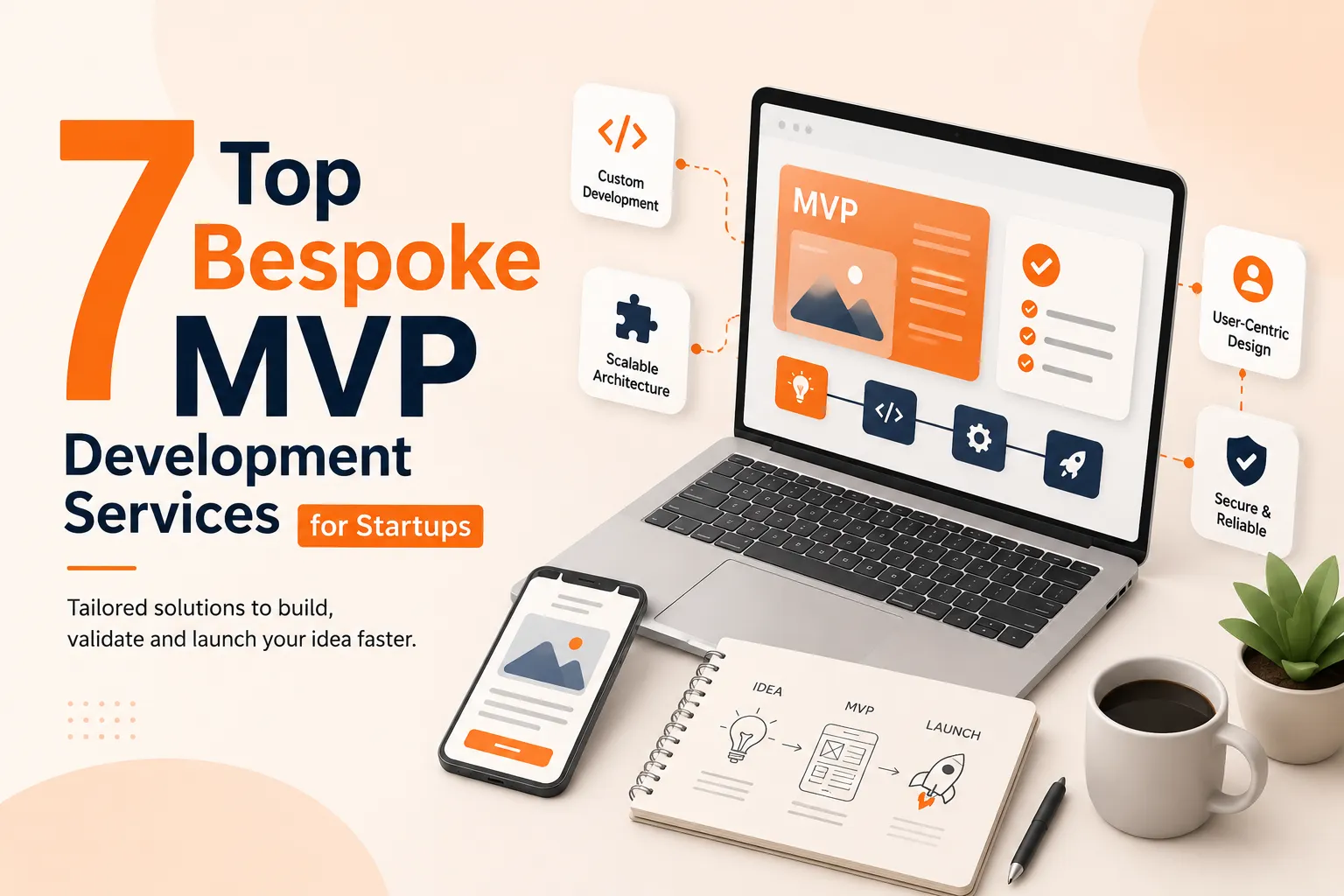
Bespoke MVP development services help startups turn a specific product idea into a focused, working MVP built around their users, business model, and validation goals. Unlike a standard development approach, bespoke MVP development adapts the product strategy, features, design, technology, and workflows to what the startup actually needs to test and learn.
Choosing the right bespoke mvp development partner matters because startups have different needs. A mobile-first product may need a different team than a complex fintech platform or a SaaS product.
This guide compares seven bespoke MVP development companies based on their startup experience, product strategy, customization capabilities, technical expertise, MVP experience, scalability, delivery approach, and post-launch support.
Quick Comparison: 7 Bespoke MVP Development Companies
|
Company
|
Best For
|
Core MVP Strengths
|
Industries
|
|
Multisyn Tech
|
Overall fit for end-to-end startup MVP development
|
Discovery, UI/UX, development, QA, launch, post-launch support
|
SaaS, mobility, business applications
|
|
Designli
|
First-time and non-technical founders
|
Strategy, UX/UI, web and mobile MVPs
|
SaaS, healthcare, fintech
|
|
Netguru
|
Product-led startups
|
Discovery, design, development, scaling
|
SaaS, fintech, healthcare
|
|
ScienceSoft
|
Complex or regulated products
|
AI, security, software engineering
|
Healthcare, fintech, regulated industries
|
|
thoughtbot
|
Product strategy and engineering
|
Discovery, design, architecture, development
|
SaaS, marketplaces, consumer products
|
|
LeanCode
|
Mobile-first products
|
Cross-platform and mobile development
|
Mobile apps, fintech, digital products
|
|
BairesDev
|
Broad engineering requirements
|
Cloud, QA, AI/data, integrations
|
SaaS, fintech, healthcare, enterprise
|
What Makes a Bespoke MVP Development Service Different?
Bespoke MVP development means building an MVP around a startup's specific users, business model, workflows, and product requirements.
A standard approach may rely on predefined features, workflows, or development patterns. A bespoke approach starts with what the product actually needs to prove and then shapes the MVP around that goal.
A bespoke MVP development project can include:
-
Product discovery: Defining the problem, users, assumptions, and MVP scope.
-
Feature prioritization: Identifying which features are essential for the first release.
-
UX/UI design: Creating user flows and interfaces around the target audience.
-
Full-stack development: Building the frontend, backend, database, APIs, and required infrastructure.
-
Integrations: Connecting payments, authentication, third-party services, or other required systems.
-
QA and testing: Checking functionality, usability, security, and performance before launch.
-
Deployment: Preparing the MVP for real users.
-
Post-launch improvements: Using feedback and product data to guide the next version.
The main difference is that the development process is shaped around the product rather than forcing the product into a predefined development model.
Bespoke vs. Standard MVP Development
|
Standard MVP Development
|
Bespoke MVP Development
|
|
Uses a more predefined approach
|
Built around specific business requirements
|
|
Limited customization
|
Customized workflows and features
|
|
Standard user flows
|
User flows designed around target users
|
|
May use predefined architecture
|
Architecture selected for the product's needs
|
|
Suitable for simpler concepts
|
Useful for unique or complex business models
|
|
Focuses on building a defined feature set
|
Connects development with product validation
|
How We Selected These Bespoke MVP Development Companies?
There is no single MVP development company that is right for every startup. The right choice depends on the product, technical requirements, budget, target users, and stage of the business.
For this comparison, we considered eight practical criteria:
-
Startup experience: Experience working with early-stage companies.
-
Product strategy: Ability to help define MVP scope and prioritize features.
-
Customization: Ability to adapt the product to specific business requirements.
-
Technical capabilities: Relevant development and technology expertise.
-
MVP experience: Experience working on MVPs and early-stage products.
-
Scalability: Ability to support the product beyond the initial MVP.
-
Delivery approach: A clear process from discovery through development and launch.
-
Post-launch support: Ability to maintain and improve the product after launch.
These criteria help separate companies based on what they can offer rather than simply comparing company size or generic service claims.
Best for: Startups looking for an end-to-end bespoke MVP development partner that can support the product from early planning through launch and iteration.
What they offer
Multisyn Tech provides MVP development across product discovery, feature prioritization, UI/UX design, full-stack development, QA, deployment, and post-launch support. Its broader capabilities include web and mobile development, SaaS development, cloud, and DevOps.
This makes it a practical option for startups that want to work with one team across multiple stages of MVP development rather than coordinating separate providers for strategy, design, development, and testing.
Key strengths
-
End-to-end MVP development
-
Product discovery and feature prioritization
-
Web and mobile development
-
SaaS development
-
UI/UX design and QA
-
Cloud and DevOps support
-
Post-launch product iteration
Notable project
The article highlights Dukkan, a smart parking and mobility platform, as an example of Multisyn Tech's product development experience. The company also works across SaaS and other startup-focused digital products.
Potential limitation
Startups with highly specialized requirements should confirm that the proposed team has direct experience with the specific technology, integrations, or industry requirements involved in their product.
Ideal fit
Multisyn Tech is a strong overall fit for startups that want a single partner to take an MVP from product planning and design through development, launch, and ongoing improvement.
Best for: First-time and non-technical founders who need product strategy alongside MVP development.
What they offer
Designli focuses on helping startups turn early product ideas into functional applications. Its services cover product strategy, UX/UI design, software development, and MVP development for web and mobile products.
Key strengths
-
Product strategy
-
MVP development
-
UX/UI design
-
Web application development
-
Mobile application development
-
Founder-focused development process
Notable project
The article highlights Designli's experience with startup products and MVP development, particularly for founders who need help moving from an early concept toward a working product.
Potential limitation
Startups requiring highly specialized AI, machine learning, or proprietary technology should confirm the relevant expertise of the proposed team before starting development.
Ideal fit
Designli may be a good choice for first-time or non-technical founders who need guidance with product planning, design, and development rather than development alone.
Best for: Product-led startups that need discovery, design, development, and ongoing product support.
What they offer
Netguru provides product development services covering discovery, UX/UI design, software development, MVP creation, and product expansion. Its broader capabilities also include AI, cloud, and other modern software technologies.
Key strengths
-
Product discovery
-
MVP development
-
UX/UI design
-
Web and mobile development
-
AI and modern technology capabilities
-
Product scaling and ongoing development
Notable project
The article references Netguru's experience with HR marketplace MVPs, Moove, and mobile application development, demonstrating experience across different product categories and development stages.
Potential limitation
Its broader service offering and structured product-development approach may be more than a very small startup needs if the goal is only to build a simple validation MVP.
Ideal fit
Netguru may suit startups that want a development partner capable of supporting them from product discovery and MVP development through later product growth.
Best for: Startups and businesses building technically complex or regulated products.
What they offer
ScienceSoft provides software development and technology services across areas such as AI, cybersecurity, healthcare, fintech, and other technically demanding sectors. Its capabilities can support products that require more than basic application development.
Key strengths
Notable project
The article highlights ScienceSoft's experience with technically complex products and industries where security, compliance, and specialized technical requirements can be important.
Potential limitation
Startups building a very small, simple MVP may not need the breadth of capabilities associated with a larger technology provider.
Ideal fit
ScienceSoft may be a suitable option for startups developing complex, security-sensitive, or regulated products where technical depth is an important consideration.
Best for: Startups that want strong product strategy, design, and software engineering.
What they offer
thoughtbot combines product strategy, UX/UI design, software development, and technical consulting. Its approach focuses on helping teams shape product ideas, prioritize requirements, and build usable software.
Key strengths
Notable project
The article highlights thoughtbot's experience working with startups and product teams that need support across product strategy, design, and engineering rather than simply outsourcing development.
Potential limitation
Startups looking for a highly specialized technology provider may need to confirm whether thoughtbot's capabilities match their particular technical requirements.
Ideal fit
thoughtbot may work well for startups that want a product-focused partner involved in strategy, design, and development, especially when the product idea still needs refinement.
Best for: Startups building mobile-first or cross-platform MVPs.
What they offer
LeanCode is positioned in the article as a specialized software development studio with particular strength in mobile and cross-platform application development. Its technical focus can be useful for startups that want to launch applications across multiple platforms.
Key strengths
Notable project
The article highlights LeanCode's experience with mobile-focused products and cross-platform development, making it particularly relevant for startups where the mobile experience is central to the MVP.
Potential limitation
Startups whose MVP depends heavily on advanced AI, complex enterprise infrastructure, or specialized backend systems should confirm that the proposed team has the required expertise.
Ideal fit
LeanCode may be a good fit for startups where mobile is the primary product experience and cross-platform development is an important part of the MVP strategy.
Best for: Startups that need broad engineering capabilities and room to scale.
What they offer
BairesDev provides software development and engineering services covering MVP development, cloud, QA, integrations, AI/data, and platform engineering. Its broader technical capacity can support startups that expect their product requirements to grow after the initial MVP.
Key strengths
Notable project
The article highlights BairesDev's experience with technically demanding products and its ability to provide engineering support across different stages of product development.
Potential limitation
A large engineering organization may be more than an early-stage startup needs when building a small MVP with a limited feature set.
Ideal fit
BairesDev may be suitable for startups that need broader engineering resources, particularly when the MVP is expected to evolve into a more technically demanding product.
How Much Does Bespoke MVP Development Cost?
There is no universal price for bespoke MVP development.
The cost depends on factors such as:
-
Product complexity
-
Number of features
-
Number of platforms
-
User roles
-
UX/UI requirements
-
Third-party integrations
-
APIs and backend requirements
-
AI or data requirements
-
Security and compliance needs
-
Development and testing requirements
For example, a simple web MVP with one user type will generally require a different level of effort than a multi-sided marketplace with separate dashboards, payments, integrations, and complex workflows.
When comparing proposals, look beyond the initial quote. Check whether the price includes product discovery, UX/UI design, development, QA, deployment, analytics, and post-launch support.
Pricing can also change as the product scope becomes clearer, so startups should request a current proposal based on their specific MVP requirements.
What to Ask Before Choosing a Bespoke MVP Development Company
Before signing a contract, ask potential development partners a few practical questions.
1. What would you remove from our initial feature list?
A good MVP partner should be willing to challenge unnecessary features and help keep the first version focused.
2. How do you define the MVP scope?
Ask how the company decides which features belong in the first release and which should wait for later versions.
3. What is included in the development process?
Clarify whether product discovery, UX/UI design, development, QA, deployment, and post-launch support are included.
4. Who owns the code and intellectual property?
Make sure the agreement clearly explains ownership of the source code, design files, documentation, and other project assets.
5. What post-launch support do you provide?
An MVP is often the beginning of product development. Ask how the company handles bug fixes, maintenance, feedback, and future iterations.
6. How will the product support future development?
The MVP should not be unnecessarily over-engineered, but the technical foundation should allow the product to evolve if the initial idea is validated.
Which Bespoke MVP Development Company Is Right for You?
There is no single company that will be the right choice for every startup. The best option depends on your product, team, technical requirements, and development goals.
Multisyn Tech
Best overall fit for: Startups looking for end-to-end MVP support covering product planning, design, development, QA, launch, and post-launch iteration.
Designli
Best for: First-time and non-technical founders who need product strategy and development guidance.
Netguru
Best for: Product-led startups that want support from discovery and MVP development through product growth.
ScienceSoft
Best for: Products with complex technical, security, healthcare, fintech, or regulatory requirements.
thoughtbot
Best for: Startups that want strong product discovery, design, technical strategy, and software engineering.
LeanCode
Best for: Mobile-first startups that need cross-platform application development.
BairesDev
Best for: Startups that need broader engineering capabilities, integrations, cloud support, or room to scale the development team.
The important point is not simply choosing the company with the longest service list. Choose the provider whose experience and development approach match what your startup needs to build and validate.
Frequently Asked Questions
What is bespoke MVP development?
Bespoke MVP development is the process of building a minimum viable product around a startup's specific idea, target users, business model, and product requirements. Instead of relying on a standard template or predefined features, the MVP is designed and developed around the core problem the startup wants to solve.
How is bespoke MVP development different from standard MVP development?
Standard MVP development may follow a more predefined development approach, while bespoke MVP development is tailored to the startup's specific requirements. A bespoke approach can include customized workflows, user experiences, integrations, features, and technical architecture based on what the product needs to validate.
How much does bespoke MVP development cost?
The cost depends on product complexity, number of features, platforms, integrations, UX/UI requirements, technical architecture, security needs, and development time. Startups should compare what is included in each proposal rather than choosing a provider based only on the initial price.
How long does it take to build a bespoke MVP?
The timeline depends on the scope and complexity of the product. A focused MVP can often be developed within several weeks, while products with complex workflows, integrations, or technical requirements may take longer. Defining the core features before development can help keep the project focused.
When should a startup choose bespoke MVP development?
A startup should consider bespoke MVP development when its product has unique workflows, a specific target audience, specialized functionality, or requirements that standard solutions cannot address well. It can also be useful when the startup expects the MVP to evolve into a larger product.
How do I choose the right bespoke MVP development company?
Look at the company's startup experience, MVP development process, product strategy capabilities, relevant case studies, technical expertise, communication process, pricing structure, and post-launch support. Most importantly, choose a company that understands what your MVP needs to validate, not just what features it needs to build.
Choosing the Right Bespoke MVP Development Partner
The right development partner should help you answer a simple question:
What is the smallest product you can build to test your biggest assumption?
Bespoke MVP development can be useful when your startup has unique workflows, a specific target audience, specialized functionality, complex integrations, or a business model that cannot be served well by a standard product template.
The seven companies in this guide have different strengths. Some focus more on startup strategy and product discovery, while others are better suited to mobile development, complex technology, or broader engineering requirements.
Before making a decision, compare their startup experience, product strategy, technical capabilities, case studies, development process, pricing model, and post-launch support.
Ready to Build Your Bespoke MVP?
If you've validated your idea and need a development partner to turn it into a focused product, explore bespoke MVP development services or learn more about MVP development services.